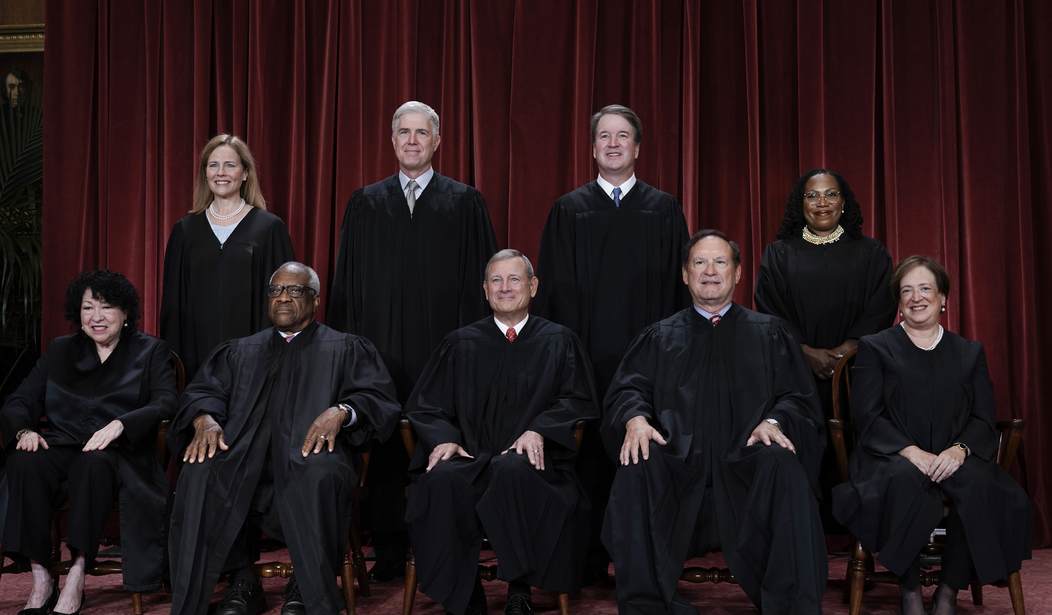
If you wondered whether you'd ever see a day in which a unanimous Supreme Court ruled that marijuana use was the equivalent to alcohol use at our founding, well, find your calendar and circle today. In a 9-0 ruling authored by Justice Neil Gorsuch, the court threw out an indictment against a man who possessed marijuana on charges of illegal firearm possession. And Justice Samuel Alito reached back to Bruen and the Founding Fathers to cement Second Amendment rights for pot users.
In US v Hemani, the Department of Justice indicted Ali Hemani in Texas after an investigation of suspected "terror-related activities" turned up nothing but the legal possession of firearms and marijuana. Hemani cooperated with law enforcement and admitted to possession of the cannabis, telling agents that he regularly used marijuana but didn't admit to using the firearms while intoxicated on it. The DoJ indicted Hemani under 18 USC 922(g)(3), "for knowingly possessing a gun in his home while being an unlawful user of a controlled substance." (That would also rely on 922(d)(3), which presumably was part of the indictment and contains that explicit language.)
While this seems straightforward – and familiar to those who followed the Hunter Biden saga – the court unanimously ruled otherwise. Gorsuch and the court make clear that they consider this charge a vast overreach, and likely a cover-your-ass prosecution when the terror allegations proved to be baseless:
Mr. Hemani is a dual citizen of the United States and Pakistan who was born in Texas and has spent most of his life there. In recent years, he has lived in the Dallas area with his parents and worked a stable job. But, suspecting Mr. Hemani and his family members of terrorism-related activities, the government conducted a search of the family home in 2022. Throughout the process, Mr. Hemani proved cooperative. He surrendered a gun he kept in the house and pointed agents to some marijuana on the property. He also consented to an interview, telling law enforcement agents that he used marijuana “about every other day.” Record on Appeal 381. After the agents found cocaine in his parents’ closet, Mr. Hemani claimed ownership of that as well, though he maintained that his mother had hidden it from him and that he had not used any recently.
More than six months after the search, the government brought a single-charge indictment against Mr. Hemani. The charge had nothing to do with terrorism—the reason for the search in the first place. Nor did the charge involve possession of cocaine, drug trafficking, or anything like that. Instead, relying solely on his admitted use of marijuana about every other day, the government prosecuted Mr. Hemani for knowingly possessing a gun in his home while being an “unlawful user” of a controlled substance. Id., at 12. For that alone, the government claimed, Mr. Hemani faced up to 15 years in prison and disarmament for life. No matter that the government did not assert Mr. Hemani was a drug addict.2 No matter that it did not contend his drug use had ever led him to pose a danger to himself or others. No matter, too, that the government did not claim Mr. Hemani had done anything with his gun other than possess it in his home.
Clearly, Gorsuch's radar was already up on the decision to prosecute Hemani at all. This looks like an attempt to make a silk purse out of the sow's ear of the original terror investigation. That kind of ticky-tack charge might hold up in other contexts, but Gorsuch writes that this crosses a core constitutional right in the Second Amendment. Before imprisoning someone for a normal exercise of those rights, prosecutors have necessarily high burdens to overcome ... and occasional marijuana use doesn't cut it, especially in light of Bruen:
All told, the government contends, because historical habitual drunkard laws resemble §922(g)(3)’s unlawful user provision in so many pertinent respects, that provision must be constitutional as applied in this case and others.
We disagree. We appreciate that drugs and guns can sometimes make for a dangerous mix. We appreciate, too, that the government’s effort to analogize a modern statute addressing drug use to historical laws must be approached with a sensitivity to the fact that many drugs well known today were unknown in early America. As we have put it, the Second Amendment “can, and must, apply to circumstances beyond those the Founders specifically anticipated.” Bruen, 597 U. S., at 28. But, even taking all that into account, the government cannot carry the burden it has set for itself. We decide cases “based on the historical record” and arguments “compiled by the parties” before us. Id., at 26, n. 6. And the habitual drunkard laws on which the government relies here differ dramatically from §922(g)(3)’s unlawful user provision on every single metric the government invites us to consider: They targeted different kinds of people, did so for different purposes, and operated in different ways. Whether any one of these problems taken in isolation would prove fatal to the government’s cause, we need not decide. Taken cumulatively, we hold, they certainly do. And, apart from pointing to habitual drunkard laws, the government has not even attempted to prove that any other specific historical principle might justify its prosecution in this case.3
The "habitual drunkard" statutes on which the DoJ relied for its Bruen test set a much different standard for behavior than anything alleged against Hemani. These statutes in the early days of the republic were aimed at those who were not just regular drinkers, but rather people so intoxicated as to be incompetent for half or more of their lives. Those laws never applied to people who used without achieving debilitating intoxication, even if they used alcohol every day, and were never used to infringe on Second Amendment rights in those situations:
Given all this, it seems the government’s historical laws targeted habitual drunkards not merely because they regularly used intoxicants, or even sometimes used them to excess. Instead, those laws focused on habitual drunkards because their drinking rendered them practically incapacitated and incapable of managing their affairs. And that hardly compares to whom §922(g)(3)’s unlawful user provision targets on the government’s account. To be sure, the government construes the term “unlawful user” to embrace only “habitual or regular” users, not those who use drugs irregularly. Brief for United States 23–25. But even on that understanding, §922(g)(3) automatically disarms anyone who regularly uses any amount of any controlled substance for anything other than its “prescribed purpose.” Tr. of Oral Arg. 57. The law, the government insists, does not require it to show that a particular individual is regularly incapacitated, much less incapable of conducting his affairs or a threat to himself or others. Put simply, on the government’s telling, §922(g)(3) sweeps in large numbers of people without regard to whether their substance use has the kind of incapacitating effect on them that historical habitual drunkard laws normally required.
This case illustrates the disconnect. The government considers Mr. Hemani an unlawful user of a controlled substance because he admits to using marijuana about every other day. But how much marijuana does Mr. Hemani use, in what potency, and to what effect? Is he routinely unable to manage his affairs, a risk to himself or his family? Or does he use a mild gummy as a sleep aid a few times a week? We do not know and, the government says, it doesn’t matter. The government asks us to analogize him to a habitual drunkard all the same.
To put this in the terms of my humorous headline: Is one toke over the line? According to this ruling, the answer is no.
The court also goes on to rule that the provision in 922(d) is overly broad, especially when used to infringe on an explicit constitutional right. First off, the government has many drugs, most of them legal, on the CSA schedule, which has five tiers, and all five tiers apply to 922(d) and 922(g)(3):
Drugs can be added to its schedules for a variety of reasons having little or nothing to do with their potential to induce violence—reasons that include “[t]he state of current scientific knowledge” about a substance, whether that substance “is an immediate precursor” to another controlled substance, and the risk to “public health.” §811(c). Without question, some unlawful users of controlled substances can pose a risk of violence. But, by defining its scope through the CSA—a statute animated by a variety of other concerns—it is far from obvious that 18 U. S. C. §922(g)(3) confines its reach to those who are categorically and unusually dangerous.
On top of that, Gorsuch writes, the federal government keeps changing its position on marijuana, even while this case was under consideration. After the court heard oral arguments, the Trump administration reclassified some cannabis products to Schedule III; during the previous administration, the DoJ itself had instructed federal agents and prosecutors to deprioritize cases involving marijuana use. States began decriminalizing marijuana before that, Gorsuch also notes. All of that undercuts the argument from the DoJ that Hemani presented a danger to the public with routine use of marijuana and the possession of firearms in his home.
Gorsuch points out the danger inherent in that argument:
Whatever one thinks of these developments, the federal government has not just tolerated them; it helped fuel them. All of which leaves it awkwardly positioned to suggest that the millions of Americans who now regularly use marijuana are categorically and unusually dangerous.
And then Gorsuch sums up the absurdity of this prosecution and its danger to civil rights:
The government maintains that it may automatically strip Mr. Hemani of his Second Amendment right to possess a firearm because he uses marijuana a few times a week. More than that, because he possessed a gun despite this prohibition, the government insists it may imprison him for up to 15 years and disarm him for life. According to the government, none of this turns on how much marijuana Mr. Hemani uses or what effect it has on him. It makes no difference either if he keeps a firearm only in his home for self-defense, never misuses a gun while intoxicated, and never poses a danger to himself or others as a result of his marijuana use. The only thing the government must show, it says, is that an individual like Mr. Hemani regularly uses any amount of any controlled substance.
As Gorsuch hints elsewhere in this ruling: If the government can prosecute Hemani under this provision, it could prosecute gun owners who take Ambien every night to go to sleep.
Alito offered an interesting concurrence, in which Justice Elena Kagan concurred, that provided the amusing historical analogy. Emphasis mine:
Marijuana consumption is increasingly common in this country. Many States have legalized its use and sale, and although possession of the drug remains a federal crime, very few persons are convicted of that offense each year. The Government has largely tolerated the production and sale of marijuana when done in accord with state law, and it has allowed a multi-billion-dollar marijuana business to develop.1 For its part, Congress has restricted the use of appropriated funds to prevent States from implementing laws that allow the use, distribution, possession, or cultivation of medical marijuana, or to prosecute certain parties that produce, distribute, or possess marijuana in compliance with state law.2
In these circumstances, marijuana use today is like alcohol use at the founding. It is widespread and increasingly considered socially acceptable in many quarters. And from a practical standpoint, law enforcement widely tolerates the use of marijuana.
That is certainly an interesting application of Bruen. It caught the eye of Justices Ketanji Brown Jackson and Sonia Sotomayor, who joined in a concurrence but renewed their objection to Bruen once again. Justice Clarence Thomas objected to 18 USC 922 entirely in his concurrence, claiming that Congress overstepped on the Commerce Clause and that this prosecution demonstrates it:
As an original matter, the Commerce Clause authorizes Congress only “to regulate the buying and selling of goods and services trafficked across state lines.” Gonzales v. Raich, 545 U. S. 1, 58 (2005) (THOMAS, J., dissenting). It gives Congress no power to regulate “activities wholly separated from business, such as gun possession.” Lopez, 514 U. S., at 599 (THOMAS, J., concurring). “[T]he power to regulate ‘commerce’ can by no means encompass authority over mere gun possession, any more than it empowers the Federal Government to regulate marriage, littering, or cruelty to animals, throughout the 50 States.” Id., at 585.
Because §922(g) criminalizes possession of firearms apart from any purchase or sale of goods and services across state lines, I doubt that it could be an exercise of Congress’s Commerce Clause powers as an original matter.
In essence, Thomas argues that this can't be one toke over the line because it never went over a state line in the first place. Clearly, the majority wanted to focus more narrowly on the particulars of this case, and it is notable that Thomas didn't have anyone else join his concurrence. He is, however, correct, or at least should be correct under the original meaning and text of the Commerce Clause. One has to wonder whether the court will have to first reverse cases like Wickard v Filburn before it will come to its senses and limit the vast expansion of federal authority that Wickard and other decisions allowed.
At any rate, this was a huge win for the Second Amendment and firearms owners. The Supreme Court is famously skittish about taking gun-rights cases, but when this court does hear these cases, they largely get it right.