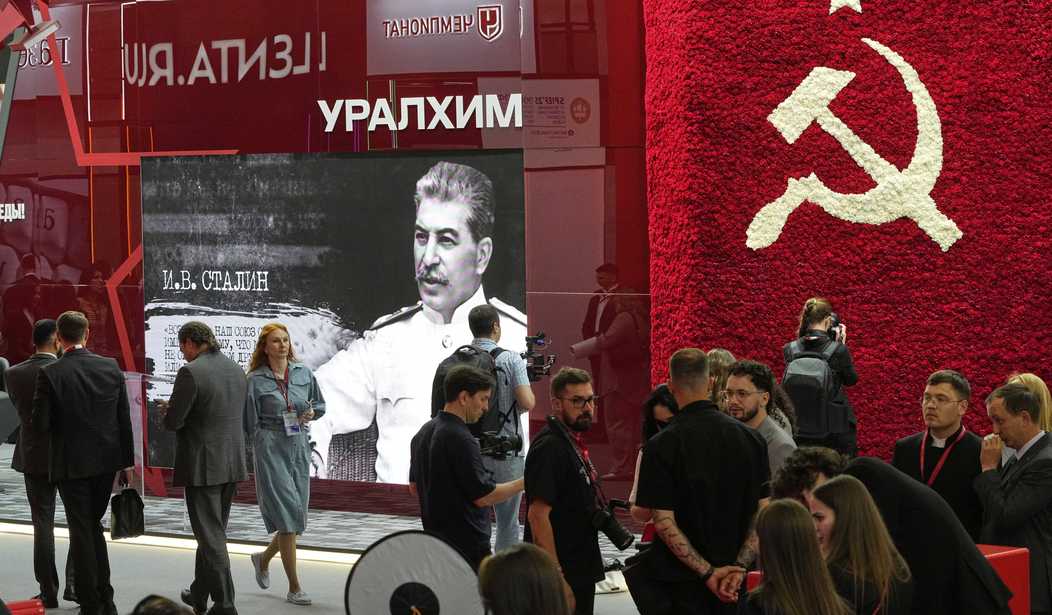
For the past several months, the editors of Hot Air have graciously given me space to promote the Anti-Communist Film Festival. Last year, I came up with the idea to have a film festival showcasing great anti-communist movies, not notably The Lives of Others, which this year marks its 20th anniversary.
I am happy to announce that the project is moving forward - despite some liberal resistance. The Victims of Communism Foundation is now the official sponsor of the 2026 Anti-Communist Film Festival. They will be providing support and hosting events at their great museum in Washington, D.C. They will also be screening some of the films there, with the idea that if demand is high, we will also rent out space in local theaters.
Soon, news of the festival and official announcements will be posted at the VOC website. For now, the GoFundMe stays active, as it is providing resources to license films and provide theater and staff support. Soon, it will be integrated into the VOC website.
During my meeting last week with VOC president Eric Patterson, we laid out the next steps to be taken. We also talked about culture. We don’t want only conservatives to come to the festival, but liberals. We want the New York Times and the Washington Post there. We believe that well-meaning liberals love America as we do, and that the ones who do not can be won over - especially with the power of film.
Our festival will not be a depressing slog through the historical terrors of communism (we’re screening Hail, Caesar!), but a celebration of freedom and of culture. One of the films we hope to show is The Unbearable Lightness of Being (1988) starring Daniel Day-Lewis. The film, based on the 1984 novel by Milan Kundera, follows the lives of two men and two women: a surgeon named Tomas (Daniel Day-Lewis), his wife Tereza, Tomas's mistress Sabina, and a professor named Franz. Their lives, which are full of love and laughter and art and dating and dancing, are disrupted by the communist takeover of their country. The story takes place during the 1968 Prague Spring in Czechoslovakia, a brief moment of relative freedom before the Soviets invaded with tanks and crushed all dissent.
The literary critic Sona Hal describes it well:
Milan Kundera’s The Unbearable Lightness of Being is an absolute masterpiece, a literary gem that transcends conventional genres and storytelling norms. It’s a captivating fusion of profound philosophy and the most unconventional love story, all woven together into a breathtaking tapestry that intricately unravels the enigma of human existence. This novel, my friends, is not just a mere work of fiction; it’s a soul-stirring experience that has left an indelible mark on my heart.
The novel and the film compare an existence that is “light,” where one can have many lovers, live freely, and avoid political conflict, to one that is “heavy” with responsibility. The heavy life is the richer, better life, closer to the earth and grounded in genuine love.
Milan Kundera is also the author of A Kidnapped West, or the Tragedy of Central Europe. The essay first appeared in the French journal Le Debat in 1983, and was reissued in book form last year. Kundera was a Czechoslovakian dissident who came to the West after being stripped of his citizenship by the communists in 1975. His other books include The Joke, an indictment of totalitarian societies that send people to the gulag for telling jokes. His books were banned in Czechoslovakia until 1989.
A Kidnapped West is a love letter to the rich cultural material that makes a civilization adored. Kundera argues that it was culture, not political ideas and abstractions, that led to the 1968 Prague Spring, where the people revolted against the puppet Socialist government. According to French historian Pierre Nora, who wrote the introduction to the reissue of The Kidnapped West, Kundera “saw … cultural vitality as an element in preparing the Prague Spring: a culture that was not a privileged invention of the elite but rather the living value around which the people itself gathered.” Kundera himself wrote that “it was the theater, the films, the literature and the philosophy that, in the years before 1968, led to the Prague Spring.” He added that “nothing could be more foreign to Central Europe and its passion for variety than Russia’s uniform, standardizing, centralizing.”
Americans don’t just respect America - we adore it. We adore our movies and novels and TV shows and comedians, or at least we did before they all went woke. We adore baseball and football, John Coltrane and Johnny Carson, Ella Fitzgerald and Tom Wolfe, Toni Morrison and Taylor Swift, Mel Brooks and Richard Pryor, Marvel Comics and Netflix, and Tom Cruise. We love being free.
This is why woke culture is so Soviet, so uniform, and so poisonous. Rather than loving the variety of cultures and traditions — some more conservative and some more liberal — that make America so dynamic, the woke try to force a humorless, totalizing society exactly like the one Kundera battled against. Kundera’s 1967 novel The Joke explored the despair and absurdity of life under Stalin, where a single joke about a government official could destroy a person’s entire life. Of course, in today’s woke culture, a politically incorrect joke can have the same effect. In recent years, Kundera himself has been in danger of being canceled by feminists, who don’t like the depiction of women in some of his books. A young Kundera today might find himself censored, or self-censoring himself, before publishing a word.
In A Kidnapped West, Kundera despairs for America. Our country, he writes, “has forgotten what it is.” A particularly potent medium to remember who we are is film. It’s an American art form that celebrates freedom and the imagination, and technology has brought us to the point where artists can be free to share their vision on the screen.
After a brief spring break, sometime in the next few weeks, there will be an official launch of the Anti-Communist Film Festival on the website of the Victims of Communism Foundation. If successful this inaugural year - and we believe the people are ready for this - we hope to expand to other theaters and perhaps even take it national. We are also researching a program to attract talented new young filmmakers.
To quote a character from The Unbearable Lightness of Being: “Love is our freedom.”
Editor's note: We now have the room to run outside commentary by some of our favorite and most provocative thinkers on the Right. That only happens because of the support of our readers, who ensure that we have the resources to keep providing an independent platform and independent voices in a sea of Protection Racket Media domination.
Help us maintain that fight! Join Hot Air VIP and use promo code FIGHT to get 60% off your membership.











Join the conversation as a VIP Member