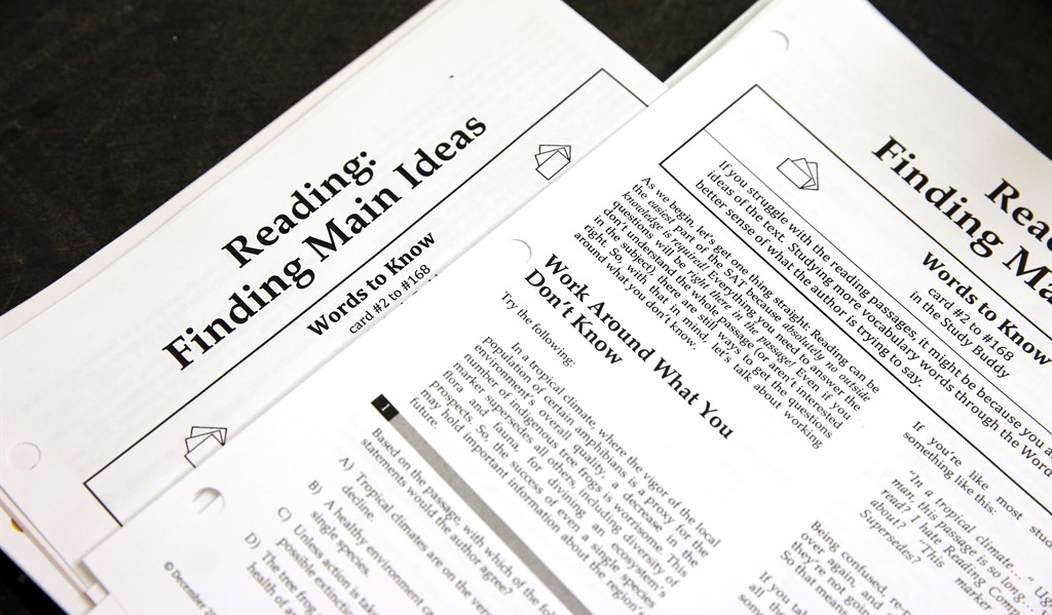
With most colleges doing away with standardized test scores like the SAT since the pandemic, essays took on even more importance. It also meant that many top schools that already got a lot of applications were getting even more than normal. Thousands of kids who didn't have the test scores to get in to a top school decided they might as well give it a shot now that test scores were optional (or not allowed at all).
It also seems inevitable that the rise of AI in the past couple years will result in a lot of students cheating by having AI write some or all of their essays for them. There's plenty of evidence from high school and college that cheating is rampant. Some believe the number of people caught is a fraction of the actual numbers of students cheating. Why? Because the clever students quickly learn how to disguise their cheating so it doesn't get caught using AI tools to make their essays sound more human.
In any case, while the amount of cheating happening on the student side of this process remains unknown, some schools are now embracing AI as a tool to help them wade through all of those essays.
Virginia Tech debuted an AI-powered essay reader in the fall. The college expects it will be able to inform students of admissions decisions a month sooner than usual, in late January, because of the tool’s help sorting tens of thousands of applications.
“Humans get tired; some days are better than others. The AI does not get tired. It doesn’t get grumpy. It doesn’t have a bad day. The AI is consistent,” says Juan Espinoza, vice provost for enrollment management at Virginia Tech...
Until the fall, each of the four short-answer essays Virginia Tech applicants submit was read and scored by two people. Under the new system, one of those readers is the AI model, which has been trained on past applicant essays and the rubric for scoring, Espinoza said.
Like many colleges, Virginia Tech has seen a huge increase in applications since making SATs optional. Last year, it received a record 57,622 applications for its 7,000-member freshman class. Even with 200 essay readers, the school has struggled to keep up and found itself notifying students later and later.
The AI tool can scan about 250,000 essays in under an hour, compared with a human reader who averages two minutes per essay. Based on last year’s application pool, “we’re saving at least 8,000 hours,” Espinoza said.
Other schools seem to be waiting to see how the experiment at Virginia Tech turns out, but it seems inevitable that, eventually, more schools are going to try to lighten the load by having AI readers. And presumably one of the things they'll be checking for is whether or not the essay appears to be written by AI.
There's also another reason to use these new tools which I wasn't aware was a big problem. Apparently, there has been a surge of fake applicants at community colleges. These fake applicants get access to federal education loans and then just steal the money and disappear. AI is now being used to help detect those fake applications.
The problem has ballooned since the COVID-19 pandemic, when online studies became more popular. Last year, [California's] community colleges had 1.2 million fake applicants, leading to roughly $8.4 million and more than $2.7 million in stolen federal and state aid, respectively.
Leaders at Golden West College in Huntington Beach used to manually screen for fake students. They looked for unusual course combinations, such as policing, dance and art, as signs of potential fraud. In recent years, overburdened staff spent spending 20 to 30 hours a week looking for fakes, said President Meridith Randall...
Today, the same fakes can be flagged using AI developed by a company called N2N Services, said Claudia Lee, Golden West College’s vice president of student services.
But if California's community colleges are eager to get some AI help, their UC system of colleges is, for now, sticking with humans.
“The human process on our side, I think, needs to mirror the human process on the other side,” said Clark, the UCLA admissions director.
My own bias would be toward human readers. That seems fair to the human writers who spent countless hours working on some of these essays. But it does make me wonder. Can human readers pick out the AI generated essays as well as the AI readers?
I have a friend who is a teacher and he tells me that, yes, it's often easy to pick out the AI work, partly because the students who resort to that option aren't careful enough to disguise it.
So I guess the way I see it now is that the students who need the least help are least likely to use AI for their essays and the ones who need the most help are least likely to get away with it. Hopefully, as the tech gets better, humans will be able to keep up and prevent people from cheating their way into college.
Editor’s Note: Do you enjoy Hot Air's conservative reporting that takes on the radical left and woke media? Support our work so that we can continue to bring you the truth.
Join Hot Air VIP and use promo code FIGHT to receive 60% off your membership.










Join the conversation as a VIP Member