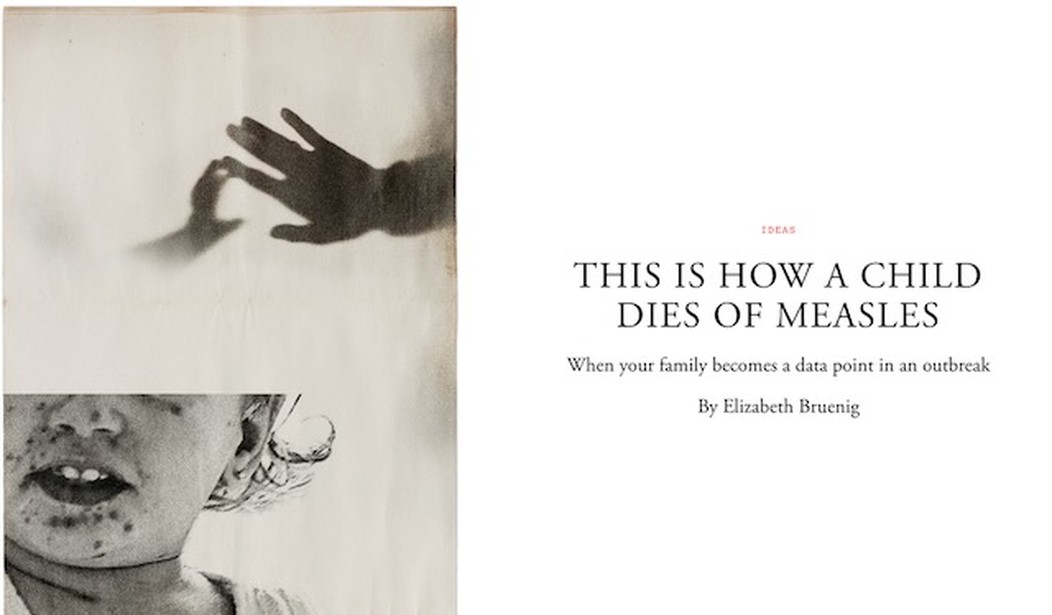
David wrote about this earlier in the week. The Atlantic published a story titled "This is How a Child Dies of Measles" which was intended to horrify people and it did. In fact the story has been a huge hit for the magazine thanks to people reading it and then sharing it with friends. But some people missed the tiny disclaimer at the bottom that the story wasn't real.
This story is based on extensive reporting and interviews with physicians, including those who have cared directly for patients with measles.
Lots of people, including some on the left felt the whole thing was dishonest. This isn't reporting it's straight fiction with some research behind it.
First, as @Megankstack and @laurahazardowen and others have noted, this piece wasn’t “reported”, it was researched; and it isn’t creative non-fiction, it is just fiction. It is not based on a real family’s story. It is entirely invented. Per Bruenig’s interview w Laura, she never…
— Rachael Bedard (@RBMD1982) February 14, 2026
And as Lydia Polgreen pointed out, it seemed intended to deceive people.
People claiming it was obvious this was a hypothetical: look at this subhed. “When your family becomes datapoint.” Only that “datapoint” is made up? No actual child died? pic.twitter.com/G3KPhCt6bY
— Lydia Polgreen (@lpolgreen) February 16, 2026
This is the equivalent of writing a story about a Minneapolis progressive being shot by ICE without mentioning that the whole thing is made up. It may spread like wildfire but that's probably because people don't know you're lying to them.
And it turns out the attempt to deceive or confuse was even worse than it appeared. Because when the article was initially sent out to people the disclaimer at the end wasn't present. On top of that, when asked directly, a spokesperson for the Atlantic claimed the story was based on a real mother's experience. Writing for Nieman Lab, Laura Hazard Owen suggests this indicates people working at the Atlantic were also confused about what this story was:
Update 2/19/2026: After this piece was published, I heard from two different people who received The Atlantic’s original press push email for the piece around 4:30 PM on Thursday afternoon. At that time, when they clicked through, there was not an editor’s note/disclaimer on the piece at all. Both of those readers, who are professional journalists, responded to the press email with confusion and asked if the story was real. An Atlantic spokesperson emailed one of these readers back and said, “This is based on a mother’s real account. Thanks for checking.” Sometime after that, the disclaimer was added and it was there when I read the story around 7 PM on Thursday night. An Atlantic spokesperson told me yesterday, “The note was added almost immediately after publication.” This information is significant to me because it suggests that within The Atlantic there was confusion about whether the piece was fictional.
David Folkenflik confrimed this:
To +1 @laurahazardowen
— David Folkenflik (@davidfolkenflik) February 19, 2026
I've also seen PDF of Atlantic piece on measles as first posted.
a/ Originally it had no editor's note
b/ PR rep initially told reporter (in note I've seen) "this is based on a mother's real account."
If Atlantic was confused, why wouldn't readers be? https://t.co/oWFlaktBWe
The Atlantic story was first published last Thursday at 3:30 pm Eastern Standard Time. I had a look at the Internet Archive version of this story and the first version was archived at 8:35 pm UTC last Thursday. UTC is currently 5 hours ahead of Eastern Standard Time so 8:35 UTC was 3:35 EST. In other words, the first archive happened about 5 minutes after the story was published. The first archive did not include the disclaimer.
Even two hours later (at 5:19 pm EST) there was still no disclaimer present. But finally at 6:23 pm EST the disclaimer appeared in the archive. So it was more than two hours and less than three before they clarified that this story was fiction.
I can't prove it but it seems likely that the disclaimer appeared because they kept getting questions from people, like the two journalists mentioned above, asking if this was real. At that point they realized they had a problem and decided to deal with it as if it should have been clear all along.
From the "journalist" herself... pic.twitter.com/5HjoCpL1Ze
— Vineyard Lives Matter (@mattresko) February 19, 2026
Creative nonfiction isn't the same thing as "careful reporting." Had a conservative tried, they would be out of a job right now. But because the author is a progressive taking aim at the Trump administration, she seems to be getting a pass.
Editor’s Note: Do you enjoy Hot Air's conservative reporting that takes on the radical left and woke media? Support our work so that we can continue to bring you the truth.
Join Hot Air VIP and use promo code FIGHT to receive 60% off your membership.









Join the conversation as a VIP Member