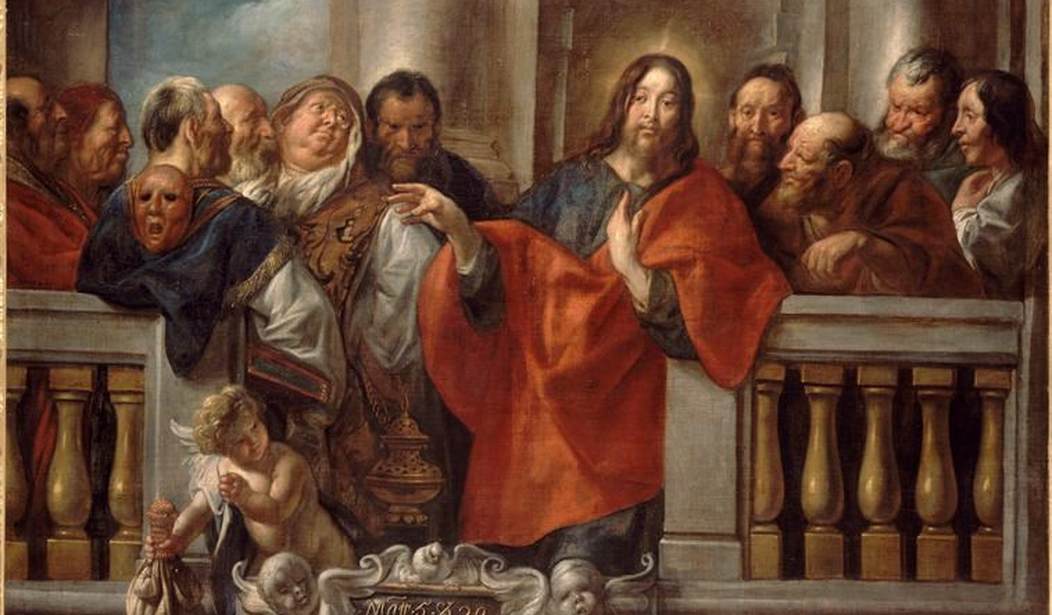
This morning’s Gospel reading is Matthew 21:33–43:
Jesus said to the chief priests and the elders of the people:
“Hear another parable. There was a landowner who planted a vineyard, put a hedge around it, dug a wine press in it, and built a tower. Then he leased it to tenants and went on a journey. When vintage time drew near, he sent his servants to the tenants to obtain his produce. But the tenants seized the servants and one they beat, another they killed, and a third they stoned. Again he sent other servants, more numerous than the first ones, but they treated them in the same way. Finally, he sent his son to them, thinking, ‘They will respect my son.’ But when the tenants saw the son, they said to one another, ‘This is the heir. Come, let us kill him and acquire his inheritance.’ They seized him, threw him out of the vineyard, and killed him. What will the owner of the vineyard do to those tenants when he comes?”
They answered him, “He will put those wretched men to a wretched death and lease his vineyard to other tenants who will give him the produce at the proper times.” Jesus said to them, “Did you never read in the Scriptures: The stone that the builders rejected has become the cornerstone; by the Lord has this been done, and it is wonderful in our eyes? Therefore, I say to you, the kingdom of God will be taken away from you and given to a people that will produce its fruit.”
As many readers already know, I have been a deep reader of J.R.R. Tolkien and The Lord of the Rings for decades. Tolkien professed a strong faith in Catholicism, although he also insisted that his works were not intended as an analogy for it. However, when reading his extensive works – particularly The Silmarillion and its beautiful origin story – it becomes very clear that his Middle Earth chronicles strongly reflect Tolkien's faith and theology.
Today's parable of the landowner and vineyard immediately calls to mind one of the key plot elements in The Lord of the Rings, perhaps because I'm just returning from vacation and spent some time digging into Tolkien analyses. Woven through all three volumes, the tale of Gondor and the lost line of kings plays a vital role in understanding the nature of the existential battle between good and evil in Middle Earth. Aragorn eventually has to come to terms with his destiny to restore the kingdom through a final battle against Sauron, although the nature of that battle and of Gondor's defense becomes complicated, to say the least.
Aragorn is not the issue that today's parable presents, however. Instead, it centers more on Denethor, the last of the stewards of Gondor who have ruled the kingdom in the absence of the royal line for a thousand years. In the books, Denethor becomes arrogant to the point of madness, refusing to acknowledge the possibility of the king's return and the rightful rule of the royal line. Denethor slowly goes mad, and while he doesn't attempt to kill Aragorn, he does attempt to kill his own son and himself with him rather than refuse to acknowledge his proper position as steward in Gondor.
Whether Tolkien intended this subplot to reflect this and similar parables in the Gospel – and I suspect those parables at least informed this part of his magnificent literature – it stands as an indictment of all stewards who forget their place.
This takes us back to original sin, and the rebellion of Adam and Eve. Their sin was not just eating the forbidden fruit, but the desire behind it. Until they partook of the fruit, they had a close relationship to the Creator, living within the caritas of God's love for them and completely accepting of his kingship, as it were. While in that relationship, death was unknown and the pair lived in eternal joy within the garden God had created.
When the serpent approached Eve, what did it promise? Not just that the fruit would be tasty and otherwise inconsequential. The serpent promised that eating the fruit would allow Eve and Adam to usurp the King and claim His creation (Genesis 3:4-5, emphasis mine):
“You will not certainly die,” the serpent said to the woman. “For God knows that when you eat from it your eyes will be opened, and you will be like God, knowing good and evil.”
Denethor represents this original sin of usurpation and rebellion. Rather than accept his role as steward of the land and working in the interests of the royal line – whose existence and identity in Aragorn Denethor bitterly acknowledges – Denethor makes himself king and refuses to cooperate with the king. His avarice blinds him, which follows into despair, and finally into madness.
And for that matter, consider Boromir, Denethor's eldest son. Boromir also rejects Aragorn's authority, and then when ultimate power presents itself in the form of the ring to him as an option to seize authority, Boromir attempts to seize it. It turns out to be a fatal mistake. His brother Faramir resists that temptation and cooperates with Aragorn, for which his father Denethor punishes him in his descent into madness.
Jesus offers His parable to warn us of that same progression of sin, and its root in original sin. The Lord created the world, and He offers us dominion of it in the form of stewardship. We can toil in it and profit from it as long as we do His will and share properly in its fruits. We find ourselves inclined to either forget that we are not the Creators of this world, or to reject the idea of a Creator altogether and assume our own personal kingship. That way leads to insanity and death, and no matter how we fight against it, the true Landlord will make a full accounting of His stewards.
This parable and Jesus' explanation are primarily aimed at the temple establishment of the time, which insisted that their status as the Lord's chosen people was irrevocable. Jesus is warning them that the Lord can and will replace them with a completely different establishment, a foreshadowing of the Church that Jesus founded at the end of His ministry. They too failed to understand their role as stewards rather than kings. However, this parable also applies personally to all who mistake stewardship for ownership, and to all who believe they can replace the King with their own will in the King's vineyard.
The King and His Son will return. Who will we be in His vineyard?
Previous reflections on these readings:
- Who owns the vineyard? Sunday reflection (2023)
- What we own, and what we owe: Sunday reflection (2020)
- What -- and who -- is the vineyard of the Lord? Sunday reflection (2017)
- Sunday reflection: Matthew 21:33–43 (2014)
The front page image is "Christ Among the Pharisees" by Jacob Jordaens, c. 1660. On display at the Palais des Beaux-Arts de Lille. Via Wikimedia Commons.
“Sunday Reflection” is a regular feature that looks at the specific readings used in today’s Mass in Catholic parishes around the world. The reflection represents only my own point of view, intended to help prepare myself for the Lord’s day and perhaps spark a meaningful discussion. Previous Sunday Reflections can be found here.
Editor's Note: Our Sunday Reflections are free to all readers, but our VIP members help keep this platform going for everyone. Join the effort by using the promo code FIGHT to get 60% off new memberships and upgrades to VIP Gold and VIP Platinum!











Join the conversation as a VIP Member