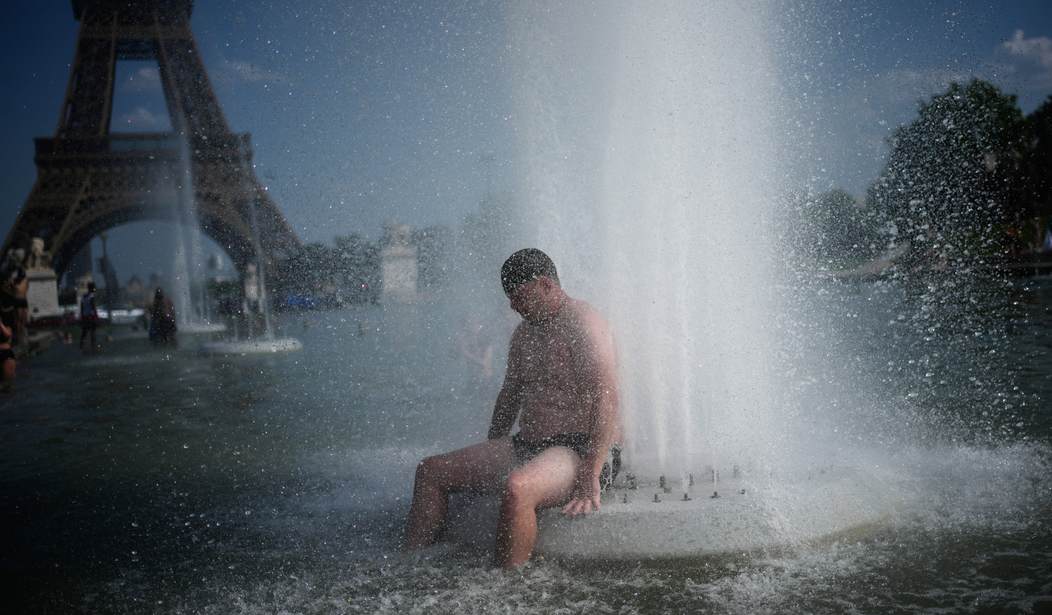
At the tail end of this past June, as you all might remember, Europe was steaming its way through the first and most brutal of the several heat waves it's had this summer.
One of the headlines from the Associated Press (via NPR) was appropriately ominous.
France records its hottest day ever as Europe withers in early heat wave
Even though, for those of us in the U.S., the 'extreme' temperatures were, like, 'summer,' it helps to remember that latitude plays a part in what feels abnormally warm (For example, Paris is on basically the same latitude as Bellingham, Washington, or Rolla, North Dakota, and London sits about level with Calgary, Alberta), coupled with general stubborn European intransigence when it comes to accepting air-conditioning as a quality of life enhancement.
...The record of 29.8 C (85.6 F) for France's national thermal indicator — an average of temperatures measured at 30 weather stations — was only the latest in a series of never-before-registered highs heaped on Europe's largest country. The conditions were likely to persist at least until the weekend.
...France's previous hottest days were recorded during heat waves of August 2003 and July 2019, with an average temperature of 29.4 C (84.9 F).
Temperature records also tumbled at individual weather stations and on consecutive days in some towns as daytime highs climbed well above 40 C (104 F), Meteo France said.
The predicted surge of heat-related deaths also, sadly, once again materialized.
So this stretch of days pretty much sucked to be not only in France, but Europe in general.
In my post on the 24th about the unfolding event, I noted how French nuclear plants were cutting back because the cooling water they were discharging would have raised the river temperatures even higher, and they were trying to protect the fish and wildlife downstream. I also had a section on the stresses in the British grid, between a die-off in wind generation and a surfeit of solar power that conversely threatened the grid with excess.
It turns out now, thanks to a whistleblower's allegations and an ensuing investigation, that the British grid was teetering far closer to the edge of disaster than anyone had any idea.
What a harrowing tale and what an unconscionable, inexcusable state of affairs.
Seconds from disaster, Britain was forced to beg France for more power
As they sat down to watch England’s World Cup showdown with Ghana, millions of football fans were oblivious to the crisis unfolding on Britain’s power grid.
It was June 23 and the country was sweltering under a heatwave, prompting many to crank up fans and air conditioners at home.
With large numbers also glued to their televisions late into the night, it meant demand on the electricity system was unusually high.
What the fans didn’t know, however, was that in a control room in Reading, engineers at the National Energy System Operator (Neso) were sweating to keep the show on the road.
At 17 seconds past 8pm, just an hour before kick-off, the crisis reached its nadir. Disaster was only averted after grid bosses begged their French counterparts for help over the phone.
Summer in the U.K., as a matter of habit, is when routine maintenance on their power plants is done, as demand has slackened and normally stays that way. So some of the plants were down for servicing, while others had unplanned outages.
According to the article, even with a fifth of Britain's power generation offline that day, they were still planning on exporting some of that excess solar to the continent. No alarm bells.
...Gas-fired power stations that usually ride to the rescue were also having a bad day. In Flintshire, North Wales, a unit at the Connah’s Quay plant had unexpectedly failed while others including Keadby 2, in Lincolnshire, Britain’s most efficient combined-cycle gas-turbine site, had seen their outputs cut because of heat inefficiencies.
But despite these early signs of a tough evening ahead, markets assumed the peak would be manageable, said Watts. In fact, Britain’s remaining interconnectors with Europe were even scheduled to export power to the Continent.
Then UNEXPECTEDLY it all went to poop.
The interconnector to France winked out, so there went the emergency back-up. The sun started to set so all that gorgeous solar dropped off like a stone, from a production high of 15 GW around lunch to 4.7GW by 6 PM But the sun was also setting across the rest of Europe, and they were switching over from solar to nuclear, etc., placing more strain on the remaining resources.
The National Emergency System Operator (NESO) gurus started to buy up spare energy capacity at spot market prices. Ouch.
...Behind the scenes, grid operators at Neso had spotted these warning signs.
Not long after 2pm, they snapped up 5.7GW of capacity in a blizzard of 111 trades at prices of up to £876 per megawatt hour – more than three times the rate on the day-ahead market.
The rest of the piece needs dramatic music as the frequency (50 Hz) required to keep the grid stable in order to prevent blackouts dropped below the legally allowed deviation of 0.2 Hz and the literal scramble was on.
Holy smokes.
...It hit 49.685Hz at 7pm, according to market data from Elexon, and then stayed outside the comfort zone for most of the next 30 minutes.
Neso control-room staff scrambled to boost supplies, calling on the country’s battery fleet to meet a large part of demand. But they were also still battling losses, with a gas-fired power plant in Cottam, Nottinghamshire, failing on its first day back from maintenance and taking 400 megawatts (MW) of capacity offline.
At 7.10pm, Neso resorted to cutting exports to Europe to keep Britain’s lights on. An emergency instruction was issued to BritNed, the interconnector with the Netherlands, to slash exports from 575MW to zero, buying vital breathing room.
This had kicked in by 7.30pm, moving the grid’s frequency back above 49.8Hz and into the normal range in a matter of minutes. It stayed that way for more of the following half-hour.
In a mere two hours, the battery backup for all of that solar power had started running down, and there was a mere 80MW of spare natural gas capacity left for the South.
Just before 8 PM, the frequency dropped below 50 Hz again, and NESO operators determined it was 'call the French and beg for whatever they can give us' time.
Three French interconnectors were able to switch directions and send much-needed juice to save the day.
Saved by the hair of le chinny chin chin that nothing else went wrong.
...Kathryn Porter, another independent analyst, claims the situation exposed the fragility of Britain’s electricity grid.
“There was no reserve left,” she wrote on social media. “This is deeply worrying, because if we’d lost a major generator that evening it could have been game over particularly with so many grid boundaries running over capacity.
“It looks like Neso ran the grid past its limit that evening and was saved by two things: France delivering extra megawatts and nothing breaking during the critical evening period.”
As it happens, something did in fact break the very next day. IFA, one of the interconnectors that came to Britain’s rescue on June 23, suffered an outage during the evening peak of June 24.
That is a dire state for an entire country to be in, and purely because they chose to impose it on themselves, chasing carbon credits and unicorn farts.
In Italy, it was also hot and expensive, but nowhere near as dramatic because Meloni has made it a point to keep many of the natural gas power plants operational and secured some of her own sourcing arrangements. This hot weather challenge has been exacerbated by lower water levels affecting the country's hydroelectric generation.
Italy’s wholesale power prices climbed to the highest since winter 2022 as hot, dry weather forces it to rely more heavily on costly natural gas.
High temperatures are boosting air conditioning needs just as hydropower reservoirs are depleting rapidly. That’s bolstered Italy’s gas use in electricity generation at a time when supplies have been tightened by the war in the Middle East.
Italy’s day-ahead power price for delivery on Wednesday rose to €208 per megawatt-hour, the highest level since December 2022, according to Italian Power Exchange data. Peak power demand is due to rise Wednesday versus the previous day, reaching 47.6 gigawatts at around 5 p.m. local time, according to forecasts from the Ggestore dei Mercati Energetici.
With all that being said, the country is still under European Union environmental constraints and must look elsewhere for extra power, too.
That 'elsewhere' is, again, French nuclear.
...Italy has also leaned heavily on neighboring markets, with net power imports averaging 7.8 gigawatts in the week through Aug. 3. France is a key source of electricity, but hot weather there has reduced the availability of some nuclear reactors, limiting how much power it can export.
You would think some of these countries, so proud of their carbon footprint but so desperate for electricity, would step back for a moment to see where they constantly reach for that juice from. And adjust accordingly.
You would think, instead of continually lurching from crisis to crisis.
Oh. I know.
DON'T TALK CRAZY TALK
Editor's Note: Do you enjoy HotAir's conservative reporting that takes on the radical Left and woke media? Support our work so that we can continue to bring you the truth.
Join HotAir VIP and use promo code FIGHT to receive 60% off your membership.












Join the conversation as a VIP Member