They are legendary names in beach history - Imperial Beach and Coronado - but the surf and sand luster has been fading in earnest for the past decade, no matter how inviting the combination of the Pacific Ocean and warm, sunny SoCal weather might seem.
On July 18, the San Diego Union had a great picture spread of the annual Sun and Sea Festival and the sand sculpture competition that they hold on Imperial Beach. Some of the sand sculptures are pretty wicked, and it's a beautiful day, with plenty of folks out.
But, for all that, you couldn't go in the water.
At the height of the tourist season, those beaches are still closed, and for many of them, it's not just high fecal counts - it's the actual fecal material washing up on the beach.
There are people in San Diego right now who bought rooms at The Coronado for $700 a night to stay on a shit island.
— Lee Kuan Yimby (@LeeKuanYimby) July 24, 2026
Tijuana has a broken sewer system...pic.twitter.com/bDU9iXXei0
Travel + Leisure magazine says, 'Oh, but you can still have fun!'
...Sitting just south of San Diego, California’s Imperial Beach ranked as one of the worst beaches in the United States for bacteria, according to a report from the Surfrider Foundation. There, the bacteria rate came in at 89 percent, the worst in the state of California, which was calculated by the number of days the beach was closed due to high bacteria levels.
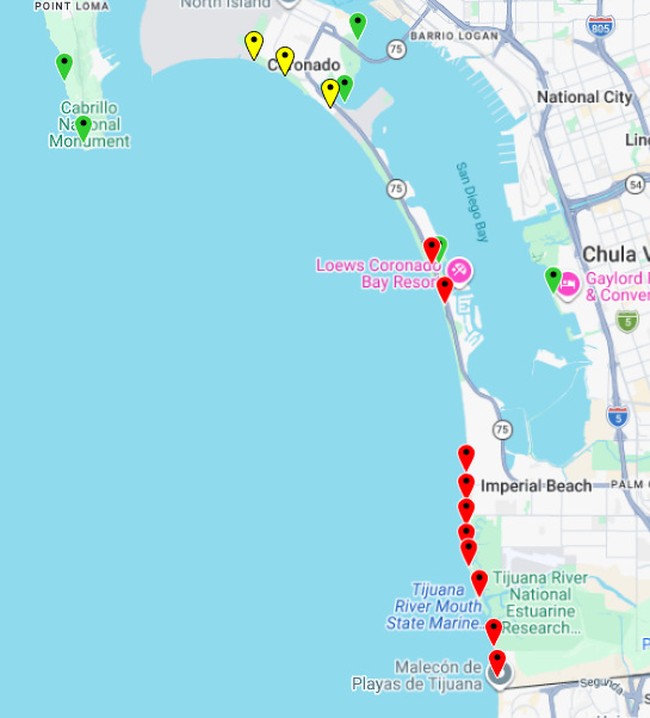
Environmental group San Diego Coastkeeper, which regularly monitors beaches throughout the year for bacteria levels, marked Imperial Beach as closed, citing an “imminent health threat associated with a sewage or chemical spill.” The closure stretches along the ocean shoreline from the south end of Seacoast Drive to north of Carnation Avenue.
The County of San Diego Beach & Bay Water Quality Monitoring Program has also flagged Imperial Beach and several surrounding areas as closed due to compromised water quality.Imperial Beach has had a longstanding issue with bacteria, named one of the most contaminated beaches by the Surfrider Foundation last year as well. Then, the beach had a slightly lower bacteria rate of 82 percent.
In 2025, the Surfrider Foundation noted a new lab was established in Imperial Beach thanks to a collaboration between the San Diego Chapter’s BWTF Clean Border Water Now programs and the local YMCA’s Camp Surf.
Even without jumping in the water, there is still plenty of fun in the sun available to area visitors. Imperial Beach is home to a pier with a lookout point, for example, where travelers can feel the sea breeze and see the San Diego coastline. The area also features traditional beach activities, such as an ice cream shop and gift shop.
Who doesn't want to pay for a 'beach' holiday without, you know, the beach?
SIGN ME UP!
A tad bit over a year ago - last April, in fact - I had a story on the sad shape of the southernmost stretch of California beaches, those stretching below San Diego proper to the Mexican border at Tijuana.
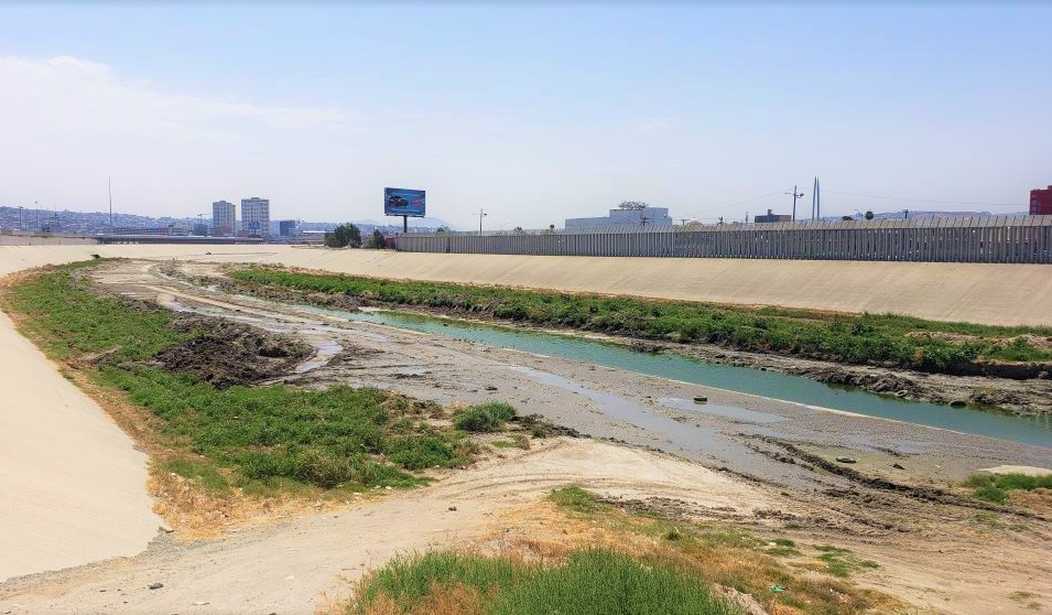
Most of the Tijuana River runs through the city until it crosses the border into the United States, fans out into a marsh, and then empties into the Pacific Ocean.
It has been Tijuana's open sewer for decades, which, thanks to floating out their refuse on the river, Tijuana shares all their filthy, disease-laden detritus with the U.S.

Environmental Protection Agency (EPA) head Lee Zeldin had been made aware of an additional six million gallon 'spill' that had occurred - this time it was another aging pipe collapse - and he was hammering Mexican officials to get the thing fixed.
Sec Zeldin - 5 miles of beach have been closed for 3 years . Need help. @epaleezeldin now heading towards the beaches our Navy seals train on and making them sick. @PeteHegseth @DeptofDefense
— Bob Weller (@BobWeller587241) April 11, 2025
The stench was so overwhelming in many of the housing developments that had sprung up in the years around the marsh and the beach that the county had started handing out air filters for residents' homes.
With the new Trump administration on its tail, the Mexican government managed to get the pumps and pipe up and running in what had to be considered record time. There was hope that the situation, festering and making a once beautiful place to live intolerable for decades, would finally be on its way to a resolution.
And much to Zeldin's continuing credit, he didn't let sleeping dogs lie. In February of this year, the EPA hit the wires with an update on the continuing efforts to get the Mexican side of the issue straightened up so life on the U.S. side would be livable again. Besides upgrading and increasing the capacity of the U.S. treatment plant processing predominantly excess Mexican sewage (how pathetic is that) from the city, Zeldin's agency had been hands-on in Mexico itself.
Administrator Lee Zeldin Provides Public Update in San Diego Area on Trump Admin Efforts to Implement 100% Solution to Tijuana River Sewage Crisis
On Friday, February 27th, U.S. Environmental Protection Agency (EPA) Administrator Lee Zeldin held a press conference at an avocado farm in Congressman Darrell Issa’s (CA-48) district where he provided a public update on Trump Administration efforts to permanently and urgently end the Tijuana River Sewage Crisis. During his remarks, he outlined various progress benchmarks that have been made since his most recent trip to the area earlier this month.
“The Trump EPA has been working every day at implementing the permanent, urgent 100% solution to the decades old Tijuana River raw sewage emergency. The agreement we signed with Mexico last year includes reduced timelines and additional necessary Mexico-side projects at no added US taxpayer cost. As these projects are completed in 2026 and 2027, with one project slated for 2028, Americans will be finally crossing the long-awaited finish line of this crisis and nightmare,” said EPA Administrator Lee Zeldin.
For Mexico-side project updates:
- EPA officials have confirmed via on-the-ground site visits that Mexico has begun construction of the effluent relocation project from the Arturo Herrera and La Morita Wastewater Treatment Plants. This is a phased project, with Phase 1 having an anticipated completion in early 2027, and Phase 2 anticipated for completion in December 2027.
- Mexico continues to make progress on the rehabilitation of the Parallel Gravity Main – Mexico secured $8.9M for this project and construction began in November 2025 with estimated completion in July 2026.
- Mexico confirmed in writing they’ve committed $34 million in federal funding to begin 5 of the 6 projects required in 2026. They are:
- Insurgentes Collector rehabilitation
- PB-Matadero and Laureles PB-2
- Poniente Interceptor rehabilitation
- Oriente Interceptor rehabilitation
- Collector Carranza rehabilitation
- EPA is closely monitoring to make sure Mexico gets the remaining amount needed to fund the PB1 energy supply as agreed to in the MOU.
- Mexico committed to investing $46 million in 2026 as agreed to in the MOU, and EPA is confirming whether this will be made up with state/local funding.
Mexico is as Mexico does, and last month, there was a 60 million-gallon rupture.
Raw sewage and stormwater. Stay kiddies indoors.
Imperial Beach has now been closed for over 1,600 days, or, for the less math-inclined, four years straight. And the effluent flow, as you saw from the video, has pushed northward into Coronado, where the average home price is about $3 million, and the nightly rate at the Hotel Coronado on the beach is princely.
San Diego County has spent almost $27 million on air filters for over 10,000 households (with an allowance of up to 3 per household).
The noxious fumes can be so bad that local schools in the still mostly working-class city have to adjust their schedules to accommodate them.
...Imperial Beach residents describe waking up to headaches, asthma and rashes after exposure to the water, or airborne pollutants from the Tijuana River. Schools invoke “rainy day schedules” when pollution levels spike. Struggling to breathe, sleep and swim, many residents of the largely working class, majority Latino community think their environmental burdens are overlooked.
And the simple, inexpensive joys of living near the water are gone for the next generation. There will be no fond bohemian beach memories for them.
...In the past, the shoreline would have been filled with campers surfing, boogie boarding and building sand castles, program director Payton Schoonmaker said. On weekends, church groups, Girl Scouts and families used to set up camp.
“Before this, you would have seen pretty much a tent city, with 300 people camping on the beach,” he said. “But now, a lot of our business has gone away.”
Oh, a 'splash pad' to make up for not being able to go in the water thanks to the third-world neighbors. 'Aquatic' activity.
Geddowddaheeyah
...Some improvements are in the works. The U.S. and Mexico have set aside a combined $800 million to fix failing sewage treatment plants, and both countries upgraded their facilities last year. Local officials are seeking $25 million to fix a site called the Saturn Boulevard Hot Spot, which is the source of much of the airborne pollution. This year Imperial Beach will build a splash pad by its pier, to offer aquatic activity near the coast, McKay said.
The cause of the sewage is 'not an American problem,' as California Post editor Joel Pollak explains. But the results are the Americans' problem, as the Mexicans are utterly incapable and unwilling to fix something that they know they can force the U.S. into acting on through their purposeful neglect.
And in fact, that is one of the stinktastic solutions being floated - that the United States takes over running Tijuana's infrastructure out of sheer self-defense.
Some of Southern California’s most popular beaches have had to close due to raw sewage flowing across the U.S.-Mexico border, California Post Opinion Editor @joelpollak explains. https://t.co/PX07vPR2mQ pic.twitter.com/CE8qky5LdL
— California Post (@californiapost) July 22, 2026
It's maddening to even contemplate such a fix...but dang. I have no doubt that the more tens of millions the U.S. spends to beef up outflow processing capacity on our side, the more the infrastructure crumbles and doesn't get replaced, never mind upgraded on the Mexican side.
It's really not a Mexican problem as it doesn't bother them in the least.
...Tijuana's explosive growth prevented infrastructure from developing at the same pace, especially in terms of sewerage and wastewater treatment. We're talking about hundreds of thousands of homes and businesses whose discharges flow directly into the sewers, pass into the Tijuana River, and end up in the ocean. Subsequently, the currents carry them northward, to the adjacent beaches of San Diego: Imperial Beach, Silver Strand, and Coronado.
This is a structural problem that is extremely difficult to solve. Tijuana would practically have to be redesigned from scratch. Any solution would come at an enormous cost, which local governments are not equipped to bear, while the federal governments of both countries lack real incentives to address the root of the problem.
These discharges have been a constant for many decades, but they have worsened as Tijuana has continued to grow.
Since the problem impacts the U.S. side most intensely, there is virtually no social demand in Tijuana to fix it, nor any political will to allocate the enormous resources it would require. This has created a cross-border free-rider problem: while both countries share the costs of the pollution, neither has sufficient incentives to take on a comprehensive solution by itself. The result is that the discharges continue to accumulate, and a structural problem has been prolonged for decades.
They don't call it a Mexican standoff for nothing, and it literally stinks.