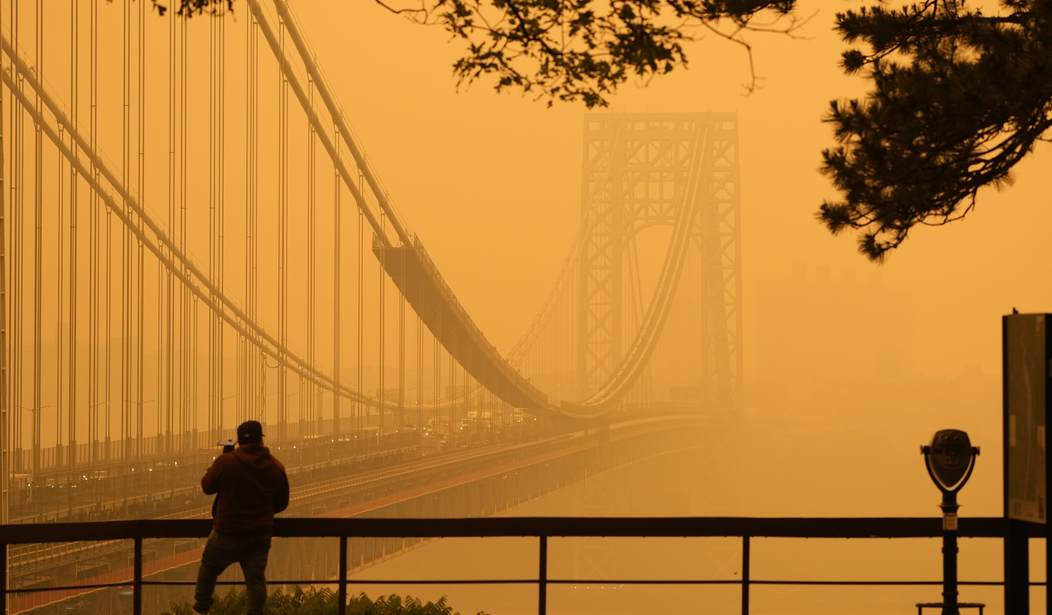
There's been quite a bit of smoke blanketing the northern states recently, thanks to a drought in Canada exacerbating their normal summer fire season.
SMOKE RETURNS 🇨🇦🔥: Plumes of smoke from the ongoing Canadian wildfires have reached parts of the Great Lakes and Northeast, causing hazy skies and a drop in air quality. Through Thursday, Americans could see the thickest smoke since the June 2023 outbreak turned skies a burnt… pic.twitter.com/wxdkAkeGxO
— FOX Weather (@foxweather) July 15, 2026
From Minnesota to the East Coast, sometimes there was a smoke haze so thick from across the border that a person could barely see the city around himself, even further south than New York City. Red alerts for hazardous breathing conditions went out, and everyone was urged to stay inside with that air conditioning we all love running to help filter the particles.
NEW: NYC issues a Code Red air quality alert as smoke blankets the region; breathing the air is equivalent to smoking 10 cigarettes. pic.twitter.com/8Sn9kmzD96
— Scope Report (@ScopeReport_) July 16, 2026
For as insane as those satellite views looked above showing the wildfires in Ontario, there are some interesting statistics available on the fires themselves.
Lightning strikes only cause 46 percent of the fires in Canada, but over 83 percent of the area that burns. Most fires in the Canadian forests have a human origin, of which arson is a small fraction, that lead back to campfires, vehicle exhaust manifolds and catalytic converters sparking on dry tinder, any number of reasons, and accidents that happen. They're also closer to inhabited areas and easier for overtaxed fire crews to get in and knock down.
The vast reaches of Canadian forest, some 9 percent of the world's total, however, are not. When the remote areas burn, the Canadians use what's known as a 'fire zonation policy.'
...This means in large areas of their jurisdictions, especially in the northern part of the country, wildfires are left to run there natural course w little or no direct action or suppression. We’ll protect values at risk, ie. infrastructure, communities, critical habitat or culturally significant features on the landscape, we’ll map them and maybe try to burn them to natural barrier, fight one flank and let the rest roll (limited action) but we are not putting them out.
On many of the fires we don’t even try. A number of these fires are huge boreal gobblers (I am currently assigned to a 250,000 ha fire, well over 600,000 acres and you could fit the org. chart on one side of a beer can).
The only thing that is going to put out this fire out and many across the country is winter, 5 months from now. It’s going to be a long, smoky summer for everyone. You have a wide reach, it would be great if you can help people understand these dynamics in the Canadian wildfire scene when they’re bitching about the smoke.
...In the industry we call this letting a fire “Do its thing”. It’s especially common in these vast boreal forests. Siberia does the same thing. Identify hazards and values at risk, mitigate, let it go....
From a Canadian firefighter who knows what’s going on: #canada #wildfire #smoke
— The Hotshot Wake Up (@HotshotWake) June 8, 2023
(Worth the read)
“I know you may know, but people need to know and understand that most Canadian wildfire management agencies have fire “zonation” policies similar to Alaska.
This means in large… pic.twitter.com/xcPbg0g345
Yellowstone National Park went to this method some decades ago, when studies after one particularly catastrophic fire proved that knocking down every fire in the park had actually made the situation worse, as it allowed the undergrowth and smaller trees to flourish, setting the stage for a hotter, meaner fire with all the additional fuel that regular fires would have swept away.
This is another horror film video from a Canadian National Railway crew trapped by a fast-moving wall of flames as they worked in Ontario last week. What the crew tried to escape in was called a 'hi rail truck,' used for track and signal maintenance and inspections. It's basically a big, heavy-duty pickup truck (think Ford 350 and bigger) with retractable, flanged steel wheels that allow it to drive on both the highway and the roads.
Trapped inside their locomotive near Armstrong, Ontario, a Canadian National Railway crew watched in horror as wildfire flames surged in from both sides of the tracks on July 14, 2026. Thick smoke filled the cab and panic set in as the fast-moving fire threatened to overtake… pic.twitter.com/QBVHl9lCWC
— ℳ𝒜𝒢𝒜_𝒳_𝒯𝒾𝓂𝑒𝓈 𝒟𝒶𝒾𝓁𝓎 𝒩𝑒𝓌𝓈🇺🇸 (@MAGA_X_Times) July 15, 2026
...Thick smoke filled the cab and panic set in as the fast-moving fire threatened to overtake them. In a desperate move, they detached part of the train to race back and rescue a stranded foreman — only to slam into their own consist in zero visibility.
When their hi-rail truck caught fire during the escape attempt, the situation turned even more dire. But once the initial chaos and panic subsided, the intense flames roared past almost as quickly as they had arrived. The crew abandoned the locomotive and ran several miles on foot down the tracks to safety, miraculously escaping with their lives as wildfires continue to rage across northern Ontario
It's a gruesome situation that our proximity to the fires means so many Americans are being forced to share.
As for the Syrupeans themselves, they're blaming Trump for literally lighting the fires.
Avi Lewis was on CNN and unbelievably said Trump lit the fires in Ontario.
— Ryan Gerritsen🇨🇦🇳🇱 (@ryangerritsen) July 20, 2026
He said he is ultimately responsible for them because of the cloud of CO2 that comes up from the U.S.
This aired just an hour before Trump imposed new tariffs on Canada. Doug Ford was also on CNN going… pic.twitter.com/Dx6rXYzLh0
This aired just an hour before Trump imposed new tariffs on Canada. Doug Ford was also on CNN going after Trump. There is no doubt Trump watched this insanity from our Politicians.
Yeah, that Doug Ford, the Premier of Ontario who threatened to cut off electricity to the United States a year ago over tariffs...
Doug Ford is complaining about Trump complaining about the consequences of the forest fires resulting from Ontario’s mismanagement of its forests.
— Viva Frei (@thevivafrei) July 20, 2026
Ford is saying Trump should help, not complain.
This is why you should weigh your words, even in battle. That time Doug threatened… pic.twitter.com/EGnWx0P5FX
...is now telling Trump to quit complaining about the smoke, and get off his a** and send help.
What happened to elbows up, tough guy?
💯...like they say "want a good neighbor BE a good neighbor but I don't thing threatening to shut off electricity to the 🇺🇸 was a good start, Doug
— Steve Mcbeth🇨🇦 (@Smacc1313) July 19, 2026
& lets NOT forget ONLY 🇨🇳🇨🇦 put tariffs on the 🇺🇸 instead of neg'...remember that Elbows thing 🤔
I LOVE THE AMERICAN PEOPLE...
Doug Ford hurls insults at Pres Trump, threatens cutting off their electricity, runs a revolting ad on American TV, goes on CNN, removes American liquor, boos their anthem, tells Canadians to boycott American made goods AND expects HELP.
— Shelley CANADA 1st (@ShelleySim30081) July 21, 2026
Let me think about that.
...ESPECIALLY WHEN OUR MISMANAGEMENT MEANS WE NEED THEM
Ontario Premier Doug Ford is asking America for help with the wildfires;
— Kirk Lubimov (@KirkLubimov) July 20, 2026
"We need support, we need help right now."
Canada sent billions in taxpayer dollars around the world in the last from Ukraine to Gaza and other black hole DEI and climate change junk while doing nothing to… pic.twitter.com/3ES0izUxjJ
...climate change junk while doing nothing to take care of responsibilities at home and now begging Donald Trump for help?
Now, there is no denying that many American folks under these noxious clouds are at the stage where they're pretty hacked off at the Syrupeans for not handling things better.
Doug Ford himself certainly could have, particularly as these fires happen every single summer.
It's almost as if Ford was using Newsom's playbook.
Yes and Doug Ford cut funding pic.twitter.com/iTI2DUmZEy
— Ms. Jackie (@pr0truth) July 21, 2026
To its own shame, the Canadian government, with a globallist trotting around the world excoriating the United States and singing the praises of the independent New World Order he's trying to start, has also neglected the 'every single summer' fire season he and his Liberal Party have whined about since they started adopting popular causes like Ukraine and Gaza to send their money to.
🔥 Canada has sent over $25.5 BILLION in aid to Ukraine since 2022 between military, financial, humanitarian, and loans.
Meanwhile, Canadian (and American) families are spending another summer under smoke-filled skies from record wildfires.
How many water bombers could that money have bought?
New DHC-515 equivalents run $50–80 million CAD each. That’s roughly 300–500+ new aircraft from the total commitments. Even the military portion (8.5B) could fund 100–200 planes.
Current reality?
Canada operates only about 60 provincially owned amphibious water bombers (mostly aging CL-415s and older CL-215s), with more through contractors. Ontario, with one of the largest forested areas, owns just 9–11. Many are 20–30+ years old.
And remember, Doug Ford's Ontario, now ablaze, cut $42M from its wildland fire budget, knowing it didn't have enough tankers.
It can be assumed that Canadians would expect the United States to send up some of the ones they'd purchased to help out, instead of buying new Canadian aerial tankers.
🔥 PART II: CANADA’S WILDFIRE PREPAREDNESS FAILURE
— Zen✨WECK (@ZenWeck) July 19, 2026
Canada did not suddenly discover wildfires in 2023. We had warning after warning.
🔥 2016 — Fort McMurray
🔥 2017–2018 — Record BC fire seasons
🔥 2021 — Lytton destroyed
🔥 2023 — Worst wildfire season in Canadian… https://t.co/OnF4fbZ7Lv pic.twitter.com/NcWsnztJly
...Canada did not suddenly discover wildfires in 2023. We had warning after warning.
🔥 2016 — Fort McMurray
🔥 2017–2018 — Record BC fire seasons
🔥 2021 — Lytton destroyed
🔥 2023 — Worst wildfire season in Canadian history
🔥 2025 — Another devastating year with mass evacuations
At what point does “unprecedented” become entirely predictable?
Canada holds nearly 9% of the world’s forests. Yet we entered this new era of extreme fire seasons with:
❌ Aging water bomber fleets
❌ Fragmented provincial response systems
❌ Limited national surge capacity
❌ Heavy reliance on contractors and ad-hoc interprovincial sharing
❌ Multi-year delays in aircraft procurement
🇨🇦 We Invented the Water Bomber… and Still Fell Behind.
The legendary Canadair CL-415 “Super Scooper” was built specifically for conditions like ours. Unlike conventional air tankers, these aircraft can skim a lake in roughly 12 seconds, scoop about 6,000 litres of water, and return almost immediately to attack the fire.
It is one of the most effective firefighting aircraft ever developed for lake-rich environments like Canada.
And yet production ended in 2015. For nearly a decade, Canada manufactured no new water bombers while wildfire seasons grew larger, longer, and more destructive.
By the time the DHC-515 program restarted, global demand had surged. European countries secured production slots ahead of Canada.
So Canada—the inventor and original manufacturer of the water bomber, home to one of the largest forested land masses on Earth—now faces years-long delivery timelines for aircraft designed for our own conditions.
And after years of recurrent, severe fire seasons, yet finally leasing some 'surge' capability, Canada's federal fire response is still a hot mess.
...Canada's wildfire aviation system remains fundamentally decentralized. Provinces own or contract their own wildfire firefighting aircraft and rely on the Canadian Interagency Forest Fire Center to co-ordinate interprovincial sharing when resources allow. That model worked when fire seasons were staggered geographically. Increasingly, they are not, and wildfires are more intense and fast-moving.
In recent years, Canada has experienced multiple Level 5 preparedness alerts, meaning every available aircraft in the country is already responding to fires. When that happens, there are no reserves left to move between provinces, and action may be taken to call for international firefighting assistance. Leasing a handful of additional aircraft may ease pressure, but it does not resolve the structural vulnerability.
...What Canada lacks is a clearly defined national aerial response framework.
That framework should establish how federally funded aircraft are deployed, how they are prioritized when multiple provinces face simultaneous fires, and how they integrate with the emerging detection technologies—including satellite monitoring and long-endurance drones—that can identify fires earlier than ever before.
Without that doctrine, the new surge capacity risks becoming another asset pool waiting for a crisis rather than a system designed to prevent one.
Current aerial firefighting strategies focus primarily on support of ground forces in proximity to advancing wildfires on human establishment and infrastructure.
It is, however, important to note that aerial suppression remains most effective in the early stages of a wildfire, when rapid intervention can prevent a small ignition from becoming a landscape-scale disaster. But that requires aircraft to be positioned strategically and deployed quickly—not simply dispatched after fires have already significantly grown.
...Yet Canada—the country that pioneered the modern water bomber—still lacks a coherent national strategy for aerial wildfire response.
The point is not simply that Canada should acquire additional firefighting aircraft. The point is that Canada must decide what role aerial firefighting should play in a national wildfire resilience strategy.
Waiting on a crisis instead of preventing one is so much better than whining that the neighbors are being mean after you spent all year smack-talking them.
That old strategy doesn't work anymore.
The walls might come tumbling down if there were more prevention action...
Trudeau promised in 2021 that $450 million would deliver new water bombers to provinces before the next fire season. Under Mark Carney’s Liberals, five years later, zero have been built or delivered federally. Canadians facing record wildfires deserve real equipment, not endless… pic.twitter.com/cayMLcFJMn
— Dante Rossi (@tvc1five) July 17, 2026
...Canadians facing record wildfires deserve real equipment, not endless delays, excuses, and broken promises.
...instead of waiting around to yell for help.
Editor's Note: Do you enjoy HotAir's conservative reporting that takes on the radical Left and woke media? Support our work so that we can continue to bring you the truth.
Join HotAir VIP and use promo code FIGHT to receive 60% off your membership.











Join the conversation as a VIP Member