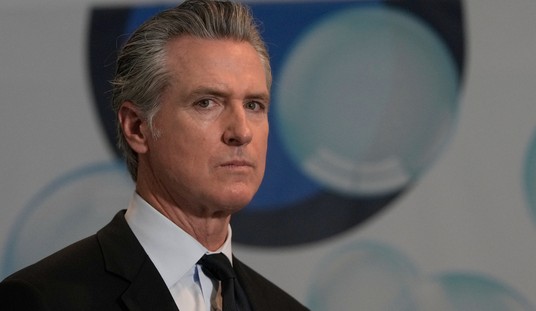
That charismatic, cutie patootie new mayor of the Big Apple - you know, the Islamic Communist?
Well, he had a big announcement the other day.
Zohran Mamdani's city-owned, city-run grocery store dream is on its way.
Zohran Mamdani announces he will open his first communist grocery store in New York next year:
— RNC Research (@RNCResearch) April 13, 2026
“I am proud to announce that we will open every single one of these stores by the end of our first term, and the first one will open next year.” pic.twitter.com/AMp8DMqXKa
One in every one of the city's boroughs by 'the end of my first term.'
(His 'first' term - didja get the hint? Cocky little bugger for a disaster so far, isn't he?)
Hizzoner used all sorts of inspiring language and allusions to yesteryear's glories to paint a vision of what's to come.
...Joined by a number of city officials, Mamdani on Monday shared the first site the city selected to house one of its new grocery stores: La Marqueta in East Harlem. The city already owns the site. Mamdani mentioned that it was a full-circle moment for the city who already experimented with the same idea decades ago.
"We are all here at La Marqueta at the same site where 92 years ago Mayor Fiorello LaGuardia stood. And he was battling a cold in the pouring rain to break down on this very institution of La Marqueta. A city-owned public market opened two years later in 1936," Mamdani said, adding that at is peak, La Marqueta served 25,000 New Yorkers.
"It cut overhead for pushcart vendors and lowered consumer cost. LaGuardia said it was "An answer to those who said they had been forgotten." The New York Times described it succinctly, 'city tries experiment.' New York City it is time for a grand experiment once again. Just like Laguardia used government to respond to challenges of the Great Depression, we will use government to respond to rising prices and unaffordable groceries."
I think the lad missed the point of what LaGuardia did and why, though, even as he invoked the mayor's name. La Marqueta was designed as a way to get hundreds of unregulated immigrant pushcarts clogging city streets and sidewalks off of them. The city had unused, unwanted property beneath a 'deafening' rail overpass and constructed a covered area where these now-regulated vendors could set up booths instead of roaming the streets, much in the style of a covered European market.
The city wasn't subsidizing the food or the vendors, just corraling them all in one vacant lot, which happened to work out for everyone.
...Originally called the Park Avenue Market, La Marqueta was established by Mayor Fiorello LaGuardia in 1936. Created as a way to regulate and control the many pushcarts that plied the streets of East Harlem, the market was designed to give permanent homes to 450 pushcart vendors in a series of five simple glass and steel structures underneath the New York Central Railroad. Residents of East Harlem quickly adopted the market as an essential resource–just four years after it was established the market was serving 25,000 patrons a day. Its success also helped LaGuardia establish other similar enclosed markets around the city.
Soon after the creation of the market, a large number of immigrants from Puerto Rico began moving into East Harlem, which had previously been a primarily Italian-American and Jewish neighborhood. It was at this time that the market became known as La Marqueta, although it still retained many of its original Jewish and Italian vendors. These vendors adapted to changing times by learning Spanish and adding new types of produce suited to Caribbean cooking. As the years past, in addition to neighborhood residents, the market also attracted Caribbean immigrants from around the city as well as Africans, many of whom worked at the United Nations.
Sadly, La Marqueta has seen its best years, even with the city dumping money into it.
...La Marqueta thrived until the 1970s, when many businesses moved to Lexington or Third Avenues, the new heart of commerce in the neighborhood. A fire in 1977 destroyed one of the market’s buildings and the others began a period of deterioration. Repeated efforts at revitalization and renovation begun in the 1980s failed to change the fortunes of the market, which dwindled to only 12 merchants by 1992. As of 2004, only one of the five market buildings remains open with only eight active vendors, although the building has been renovated and remodeled. Despite its dramatic decline, several long-time vendors remain and many loyal customers who have not lived in East Harlem in years return regularly to shop at La Marqueta.
Perhaps this was not the best place to launch from symbolically?
Mamdani is also not the sharpest tack in the box. And his administration is going to give the struggling La Marqueta yet another go. Only this time, instead of individual entrepreneurs, the city is footing the whole tab for 'culturally relevant,' affordable, subsidized food.
..."When corporations control every part of the food supply chain, prices go up, wages stay flat, and workers and customers both lose," the mayor said in an earlier statement. "That is why we are advancing a public option -- one rooted in the belief that our city can and must intervene where the market has failed.
"We cannot accept a status quo where even the most basic necessity -- putting food on the table -- feels out of reach. This is about ensuring that every New Yorker, regardless of income or ZIP code, has access to fresh, healthy food at a price they can afford."
...The mayor's office said a city-run grocery store at La Marqueta is expected to serve as a boon to an East Harlem community long plagued by affordability issues, with nearly 38% of households having received public assistance, or SNAP, in the past year, and 59% of households being unable to afford basic needs.
As with all of Mamdani's pie-in-the-sky plans, money is the sticking point. Most of his proposals have been met with a 'hard no' from Governor Kathleen Hochul or his former assembly mates in Albany - like wealth taxes and free bus rides - so the mayor is being hard-pressed to come up with something positive to show for all his big talk.
Also, his big money. What's with thirty million for a grocery store - a minimalist city-size grocery store at that? One that they don't even have to buy or rent the land, as it's already city-owned?
In a city with plenty of grocery stores for sale in that area which they could refurbish.
Aldi apparently spends a fraction of that building or refurbishing purchased properties to launch its very popular stores.
Mamdani is on crack, unless his endgame is obtaining real estate at gov prices.
— Urahara Kisuke 🇺🇸 (@UraharaGaiden) April 15, 2026
Put up a failed supermarket, tear it down, then lease for some other enterprise a few years in the future.
the probability that this will fail is very high (80-95%) or more within 5-10 years. pic.twitter.com/kbaX1Ymp7d
Mamdani also has 'budgeted' $70M for his five stores. This one is already at $30M.
🚨 NEW: Zohran Mamdani's first "FREE" grocery store is already BURNING UP the budget, and it's going to take a YEAR to open
— Nick Sortor (@nicksortor) April 13, 2026
SHOCKER! 🤣
Mamdani budgeted $70 million for FIVE groceries stores, but this first grocery store ALONE will cost $30 MILLION
Communism doesn't work! pic.twitter.com/vjKe5qUkMA
That's progressive #mathz for you.
Then there's 'when' it will be ready. This first project is already a little behind the timeline curve, as it was supposed to be opening next year, but now won't be handing out broccoli, kombucha, and whatever else is 'relevant' until 2029.
No one can quite figure out what's going to take so long to build a smallish grocery store. Down here, they can throw a massive Publix up from clearing the alligators out of the swamp to stocked shelves in under a year.
Also, this was one of Zohran's key campaign promises.
— Michelle Tandler (@michelletandler) April 14, 2026
Now he is saying it will take *three years* to build a simple store?
Wouldn't it take < 1 year for a normal developer?
This seems like some sort of weird psyop. Like "fulfill" the promise, but not really.
This is beginning to sound like the grocery version of a high-speed rail line.
So much for promises, promises.
He’s selling a “basket of goods.”
Mayor Zohran Mamdani admitted Tuesday that the promised lower prices at his city-owned grocery stores will only be guaranteed for a core set of everyday staples.
Items in those so-called baskets of goods have yet to be decided, but likely include essentials such as bread, milk and eggs, officials said.
Beyond those essentials, the stores will also sell other foodstuffs and items. Officials said they’ll aim to make those items low-cost as well, but may not always be able to achieve the perpetual discount.
I worked at a grocery store for years before I went into the Marine Corps. Such bargains on bread, eggs, and milk are called 'loss leaders,' and they're common, not special.
Mamdani's selling a loaded basket, alright, but this is a family-friendly site, so I can't tell you with what.
As I saw someone point out during my research, this $30M basketload bomb is only a mile from a Costco.
Yes! @WhitneyTilson suggested that during his campaign.
— Michelle Tandler (@michelletandler) April 14, 2026
$30M could likely buy 600k memberships at $50 each per year.
Of course, there are two problems with the equally accessible and just as cheap alternative to the Mamdani multi-million dollar food palace.
The first and most obvious is:
Yes but Costco requires ID. clearly racist.
— lakewood bochur (@boings1) April 15, 2026
The second is that there is no opportunity for grift, which is, naturally, more important to the people involved in the project.
No worries, says the mayor. It's as easy as shoveling snow.
..."Now, some will insist that city-owned businesses do not work, the government cannot keep up with corporations," Mamdani said. "My answer to them is simple. I look forward to the competition."
The bodega owners of the city are not happy with the mayor's plans, giving them a big, fat NYC raspberry.
...Critics say city-run supermarkets will hurt ordinary bodega owners and could even produce chaotic lines for cheaper groceries.
"These stores are going to get jam packed, they're only four or five in the entire city of 8 million people," said Fernando Mateo with United Bodegas of America. "What do you expect is going to happen? You're going to have people rushing to these stores early in the morning to late at night, waiting on long lines. You know, it's going to be more turmoil than anything else. It's a great punch line for him and for the socialist movement. But New York is not a socialist city."
I will lay you dollars to donuts it produces more than 'chaotic lines' when people in the stores find out they only get a 'basketload' of city-determined bargains and the rest are damn near the retail they normally paid but wouldn't have had to walk as far to buy.
Oh, yeah. Guaranteed, there are gonna be throwdowns and 'Clean-up at register five!' every other hour.
For what doesn't just walk out the door on its own.
Thirty million. Man.