You may have walked into your neighborhood Target, after perhaps (depending on where you live) driving past who-knows-how-many other Targets, and thought to yourself, "Wow. This is a big, big business."
And you'd have been right. Huge "big box" retailers like Target, CVS, Walgreens and the big kahuna, Walmart, are indeed massive, with employee counts in six-plus digits and annual revenues in twelve figures.
And each of them is an American free-market success story, earning success by bringing products customers want at prices they can afford, and doing it consistently as others (anyone remember Sears, KMart or Woolworth?) fail. And in doing so, they've disrupted a lot of small businesses that couldn't match their economies of scale, forcing some redirection of local capital and energy - which is, again, the free market in action.
But each of them has also benefitted from government largesse at several levels - from local real estate tax breaks to exemption from COVID lockdowns - carve-outs that smaller businesses didn't have the political or market clout to demand, much less get.
I'm imagining how many owners of mainstreet general stores, drugstores, TV shops, record stores and other local entrepreneurs watched their top and bottom lines racing toward the red over the past five decades and thought "I wish Congress would do something for us".
As those same businesspeople no doubt also knew, "it ain't what you know, it's who you know".
Which is why some of those very, very big businesses confront the market power of even much, much bigger businesses.
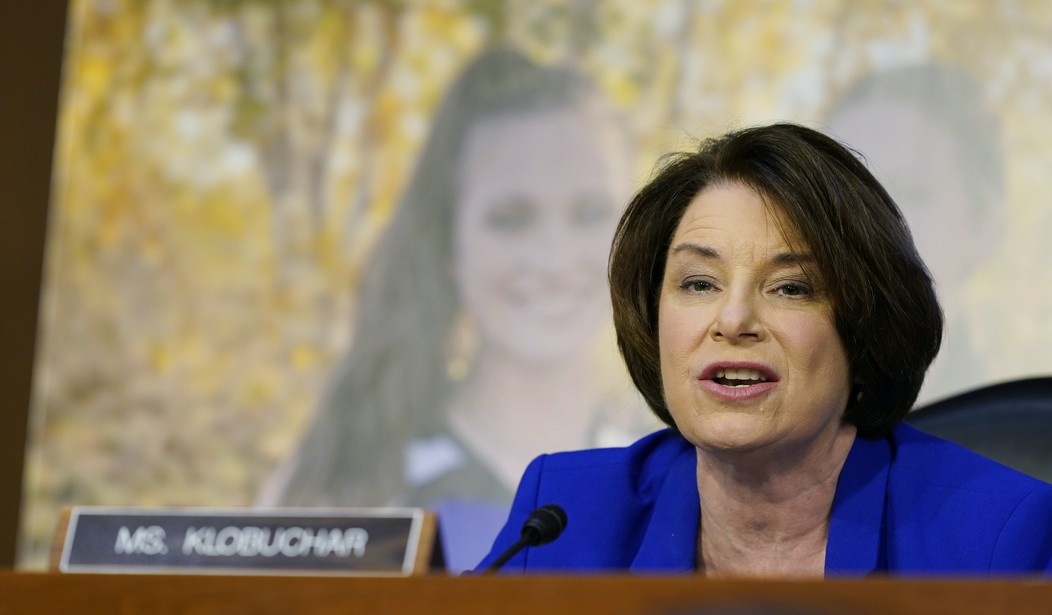
The "American Innovation and Choice Online Act" (AICOA) is a bipartisan bill co-sponsored by Senator/Gubernatorial candidate Amy Klobuchar (D-MN) and Chuck Grassley (R-IA). The stated goal is to harness government power to allow very very big businesses to protect themselves against ultra-super-ridonkulously big businesses, like Amazon, Google, Apple, and Meta.
AICOA would allow the Department of Justice (DOJ), the Federal Trade Commission (FTC) and state attorneys general to challenge the world’s largest online platforms for discriminatory or exclusionary conduct that harms competition. AICOA preserves legitimate safety, privacy, intellectual property, national security and constitutional protections, as well as popular services provided by large digital platforms.
So what is the dividing line between plucky, scrappy little local businesses and the really big businesses that they "need" to be protected from?
It comes down to two terms - "covered platforms", or companies with "only" 50 million or fewer users and 100,000 or fewer affiliated businesses, and "systematically important platforms", which are online platforms controlled a person, and with average gross revenues of over $175 billion, reaching over 34 percent of US households or active users over age 12. Don't forget that 34 percent figure - it's going to be important in a bit.
If that sounds awfully specific, that's because it is. The intent is to allow the DOJ, the Federal Trade Commission and state attorneys-general to target companies that fit the "systematically important" label - Amazon, Apple, Alphabet, Meta. (If you're one of those small businesses that's been hobbled by the big guys? No - it doesn't create a right of action for any of you).
And those $175 billion and 34 percent reach figures aren't remotely accidental.
Target had $106 billion in revenue in the most recent accounting year. Walgreens/Boots, almost $155 billion. CVS? A little over $400 billion in revenue, but they don't come close to covering 34 percent of monthly users with the CVS online app, so they don't meet the standard.
One would be forgiven for noting that CVS is headquartered in Senator Whitehouse's Rhode Island. Walgreens hails from Senator Durbin's Illinois. And Target is, at least for now, an economic tentpole in Amy Klobuchar's Minnesota.
The bill essentially gives very big businesses a little extra thumb on the scale with bigger, big business.
If it sounds familiar to you - well, that means you're a business nerd. But it isn't a new idea; it is essentially a copycat of the European Union's (EU) "Digital Markets Act" (DMA) - which brokers clout the same way in the EU.
The DMA and AICOA both restrict "Systematically Important Platforms" from limiting the ability of a smaller business - say, a mere, plucky little underdog of a "covered platform - to compete against the platform operator’s own products or services, enact terms of service that favor the platform, use nonpublic platform data to compete with the smaller huge businesses, or otherwise giving favorable treatement to the "Systematically Important Platform's" own products and services.
Essentially, it ties one hand of super-di-duper big companies behind their backs, on pain of government-funded harassment. But not mere super big companies.
Because it is, apparently, who you know.