
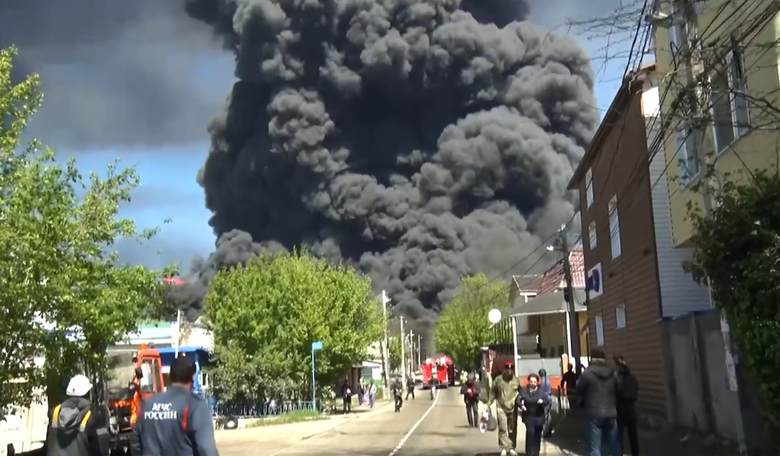
There was a brief moment where Ukrainian attacks on Russian oil refineries stopped last month after intervention by Elon Musk and/or President Trump. However, that didn't last very long.
Since late October, Ukraine has carried out strikes against nine refineries which Reuters estimates have reduced Russia's total refinery output by just shy of 30 percent.
Ukrainian attacks disrupted operations and caused emergency situations at nine of Russia's 35 major refineries over the past week, according to industry sources and officials.
According to the industry sources, the combined daily nameplate capacity of Russian refineries affected by drone attacks since late October, including three major plants in central Russia, stands at around 300,000 metric tons, or 2.2 million barrels, compared with Russia's total primary refining capacity of about 930,000 tons per day.
At the end of October, Russian refineries were processing about 700,000 tons, or 5 million barrels, of crude per day, according to the sources.
The sources estimate that the actual reduction in crude processing at Russian refineries could be up to 200,000 tons per day.
The short version is that they have probably taken out about 28 percent of Russia's actual output in less than two weeks. Here's a map showing the locations of the 9 attacks.
And... another one. Last night, Ukrainian 🇺🇦 forces struck the 8th Russian 🇷🇺 refinery in 10 days, after multiple drones struck the Kirishi refinery This campaign has been very successful these last few days and this is a severe blow to Russia's economy despite the "diesel deal" https://t.co/owRPwp44rS
— Clément Molin (@clement_molin) November 9, 2026
The most recent attack happened at Russia's 2nd largest refinery in Kirishi.
🔥🛢️Ukrainian drones attacked Russia’s Kirishi oil refinery in Leningrad Oblast overnight on November 9, causing a large fire at the facility. Kirishi is Russia’s second-largest oil refinery, with a processing capacity of around 20 million tonnes of crude oil per year, accounting for roughly 7% of the country’s total refining capacity.
— Special Kherson Cat 🐈🇺🇦 (@bayraktar_1love) November 9, 2026
💥 One of Russia’s largest oil refineries hit overnight — massive fire erupts in Kirishi The Kirishi oil refinery in Russia’s Leningrad region came under attack overnight. Monitoring channels report a major fire at the facility. This is Russia’s second-largest oil refinery, capable of processing 20 million tons of crude oil annually — roughly 7% of the country’s total refining capacity. And it’s not the first time the plant has been targeted. Drone strikes in May and September previously forced it to suspend operations. Now Kirishi is burning again.
— NEXTA (@nexta_tv) November 9, 2026
BREAKING: A large Ukrainian drone swarm has struck Russia’s second-largest oil refinery Kirishi near St Petersburg. The drones have caused significant damages, with fires currently raging at the refinery. https://t.co/9D7aZAgK3S
— Visegrád 24 (@visegrad24) November 9, 2026
The result of all of this is that Russia has once again started limiting gasoline sales in many regions of the country.
Ukrainian drones struck the KINEF refinery in Russia's Leningrad region on Monday, causing major fires and damaging three oil processing units...
KINEF, the largest refinery in northwest Russia and second largest in the country behind the Omsk facility, is owned by the Surgutneftegaz group and processes roughly 18 million tonnes of crude oil a year, about 7% of Russia's total refining capacity...
Rosneft announced on Monday it was capping petrol and diesel sales at its filling stations. The restrictions took effect in Karelia, Buryatia, Zabaykalsky Krai, and the Novosibirsk, Arkhangelsk and Penza regions, according to Russian media.
In cities, customers are limited to 30 litres of petrol per transaction; on motorways, the cap is 50 litres.
30 liters works out to 8 gallons of gas. How have these attacks been so successful if reliance on Starlink has been reduced? Well, because all of these refineries are inside Russia, use of Starlink was never allowed for these attacks. Ukraine's long range attack drones, like the FP-1, instead use other means to locate targets, including access to an Israeli satellite system.
Meanwhile, talks are underway in the UAE between Russia, Ukraine and the U.S.
ВЕЛИКИЙ ДЕНЬ ДИПЛОМАТІЇ: ПЕРЕГОВОРИ ЩОДО УКРАЇНИ ОДНОЧАСНО ПРОХОДЯТЬ У ФРАНЦІЇ ТА ОАЕ Сьогодні, 10 листопада, одразу на двох дипломатичних майданчиках обговорюють шляхи завершення війни та підтримку України. 🇦🇪 В Абу-Дабі українська делегація на чолі з Рустемом Умєровим провела консультації з представниками Великої Британії, Франції, Німеччини, Італії, НАТО та Єврокомісії. Після цього, за повідомленнями, розпочався тристоронній етап переговорів за участю України, США та Росії. Американську сторону представляють Стів Віткофф і Джаред Кушнер. 🇫🇷 У Парижі глава МЗС України Андрій Сибіга зустрічається з держсекретарем США Марко Рубіо. Далі — переговори міністрів закордонних справ G7, присвячені підтримці України. Головні питання — припинення бойових дій, гарантії безпеки, економічне відновлення та гуманітарні домовленості. #Україна #Переговори #АбуДабі #Париж
— UNN Media (@unn_inc) November 10, 2026
Today's talks lasted about 4 hours:
The two-day session in the UAE’s capital, Abu Dhabi, is the first such meeting since February. It will focus on establishing future security guarantees for the warring countries, the White House said before the discussions. Russia sees NATO as a threat, and Ukraine wants to prevent future Russian invasions.
The first day of talks concluded after nearly four hours, the RIA Novosti news agency said. They are expected to resume Wednesday, according to the press office of the Foreign Intelligence Service of Ukraine.
U.S. President Donald Trump’s son-in-law, Jared Kushner, who along with U.S. envoy Steve Witkoff is trying to broker a settlement, said he believed there were “some good ideas how to bridge” the differences between the two sides.
Outside of that room, there are no signs that Russia is ready to end the war.
Russia's Nebenzya confirms that Russia is not ready for any real peace negotiations ahead of the talks in Abu Dhabi: "We will not agree to a freezing of the conflict that would preserve existing threats to our security and create conditions for a new escalation. Our position is firm and unyielding. The settlement must be comprehensive, durable, and long-lasting. It must address the root causes of the conflict." Russia sees an independent Ukraine as the main threat to its security.
— Anton Gerashchenko (@Gerashchenko_en) November 9, 2026
Foreign Minister Lavrov also doesn't sound interested in a peace deal.
Lavrov commented on the Abu Dhabi talks. He says all the EU and Ukraine want to talk about are an immediate ceasefire. He confirmed that Russia would not agree to this. Then, confirming that the USA want to discuss the European security architecture, Lavrov mocks the EU participation: "let them sit in the hotel there." No real readiness for negotiations is visible from Russia.
— Anton Gerashchenko (@Gerashchenko_en) November 10, 2026
Of course they have to talk tough for the benefit of the domestic audience, whether reality supports that talk or not. Still, if the destruction at 9 refineries in as many days is having an impact on Russian thinking, I'm not hearing it. We'll see if the end of talks tomorrow brings any better news.