






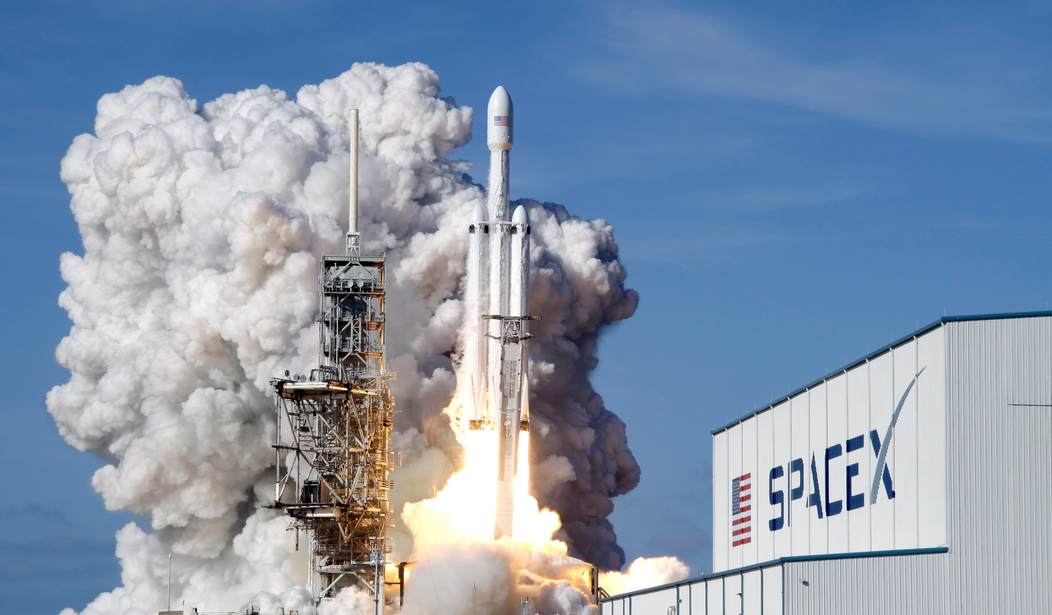
If all goes well, SpaceX will be launching a brand new space telescope this Sunday. The scope is named for a former NASA chief of astronomy.
NASA's Roman Space Telescope, named after the late NASA astronomer Nancy Grace Roman, will launch no earlier than Sunday on a mission to map the galaxy like never before. Liftoff is set for 7:26 a.m. EDT (1126 GMT) from a NASA pad in Cape Canaveral, Florida...
The company will launch Roman into space atop a Falcon Heavy rocket from Launch Complex 39A at NASA's Kennedy Space Center in Florida. A launch livestream will begin about one hour before liftoff.
If all doesn't go well Sunday, the company will have another chance to fly on Monday.
So what's new about the Roman Space Telescope? The mirror is the same size as the one that was inside the Hubble Telescope but it's designed to cover a much wider field of view. This description is a bit nerdy but interesting if you've ever owned a telescope.
Both Hubble and Roman are reflecting telescopes. They use curved mirrors instead of lenses to collect and "bend" light to their various instruments. Hubble is a Ritchey-Chrétien Cassegrain telescope that uses two hyperbolic mirrors to direct light to its instruments. Hubble’s large primary mirror sends incoming light to its secondary mirror that is centered directly above the primary mirror. The secondary mirror guides that light back to the primary mirror where it passes through a hole in the center and to Hubble’s scientific instruments, located behind the mirror. Such Cassegrain designs offer a long focal length (the length of the path that incoming light takes to come into focus) in a relatively compact package by "folding" the light path back and forth. The longer the focal length relative to the diameter of the main or primary mirror, the higher the magnification and depth of field.
Roman's design is similar to Hubble's, but it uses three curved mirrors instead of two. Its mirrors are shaped to a precise surface curve that gives the telescope a focal length that is roughly three times shorter than Hubble’s. The shorter the focal length relative to the diameter of the main or primary mirror, the wider the field of view. Roman’s Three-Mirror Anastigmat design achieves better optical performance over a significantly wider field of view compared to Hubble’s design.
Both Hubble and Roman have the same size primary mirror (7.9 feet or 2.4 meters wide), but thanks to newer technologies, Roman’s primary mirror is more than four times lighter — 410 pounds (186 kilograms) compared to Hubble’s hefty 1,825 pounds (828 kilograms)...
Although both primary mirrors are the same size, Roman has a much shorter focal length than Hubble, helping its Wide Field Instrument achieve a view that is 100 times larger. That broader vista gives Roman the ability to survey large swaths of sky in a short time. With more than three decades of observations, Hubble has only seen one-tenth of one percent of the sky. During its first five years, Roman will image 50 times as much sky as Hubble captured in 30 years.
One of the benefits of the new design should be the ability to survey the entire Milky Way in a month.
Another goal of the telescope is to spend a month surveying all the stars in the Milky Way galaxy. Julie McEnery is Roman's project scientist. She says even though Roman has broadly the same sensitivity and sharpness of vision as the currently orbiting Hubble Space Telescope, its design lets it do things much faster.
"That one month of observations to survey our Milky Way galaxy would take about a century with Hubble," says McEnery.
It will also allow us to identify lots of new extrasolar planets.
One professor eager to get his hands on Roman data is Scott Gauti at The Ohio State University. Along with colleagues, Gauti developed a technique for detecting planets around distant stars. It's called gravitational microlensing, and it measures the way those planets bend the starlight that passes them by.
Albert Einstein described the idea in 1936 but thought it would be impractical. New technology has proven him wrong — and Gauti expects Roman will find tons of planets that way.
"We're looking for planets that are just completely undetectable by any other method," Gauti says. That includes planets at the center of our galaxy, "that are very analogous to our own solar system planets like Jupiter, Saturn, Uranus, and Neptune."
Finally, this particular telescope has an interesting backstory. It was a redesign of a U.S. spy satellite.
The clandestine side of the Roman telescope’s story begins in 2012, with a surprise that landed on NASA’s doorstep at the agency’s Goddard Space Flight Center: a pair of once-classified spy satellites.
The satellites were gifted to NASA by the U.S. National Reconnaissance Office (NRO), the military agency tasked with the design and construction of the U.S. federal government’s intelligence-gathering satellites.
The Roman Telescope is a modified version of one of those two former spy satellites NASA received in 2012, which were originally developed for looking back toward Earth, rather than scouring the cosmos for signs of exoplanets and signs of some of the universe’s most elusive phenomena.
The launch window is the middle of the night for me here in California but I'll be checking in on how things went a bit later. Exploring the universe is one of the things I believe we're here to do, so I'm excited to see happen.
Editor's Note: Do you enjoy HotAir's conservative reporting that takes on the radical Left and woke media? Support our work so that we can continue to bring you the truth.
Join HotAir VIP and use promo code FIGHT to receive 60% off your membership.



Join the Conversation
VIP members get the ability to comment on articles.