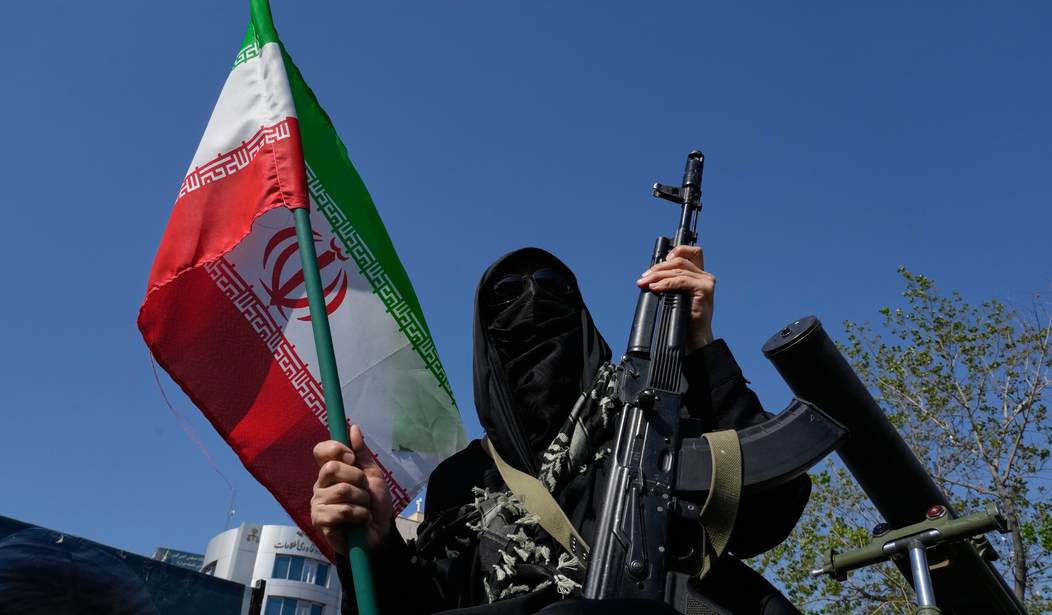
President Trump's plan to blockade the Strait of Hormuz rather than drop bombs on Iran has a lot of advantages. For one, it keeps American troops further away from Iranian defenses. We've already seen once that it is possible for Iran to shoot down an American jet. In that case we managed to get both pilots back before Iran could turn them into hostages, but we might not always be so lucky. Second, Trump's plan also avoids the problem of civilian casualties which are unavoidable in a massive military strike.
But the blockade has one obvious disadvantage. It gives time for Iran's leaders to dither and make offer they don't expect anyone to accept. After all, it's not going to be the leadership of the IRGC that is running out of money or food, at least not first. The same hardliners who were murdering their own citizens a few months ago are more than happy to let them suffer for the regime.
So the question becomes: How long can Iran hold out before a complete economic collapse? Today there's a report that the CIA has offered the White House an estimate.
A confidential CIA analysis delivered to administration policymakers this week concludes that Iran can survive the U.S. naval blockade for at least three to four months before facing more severe economic hardship, four people familiar with the document said, a finding that appears to raise new questions about President Donald Trump’s optimism on ending the war.
The analysis by the U.S. intelligence community, whose secret assessments on Iran have often been more sober than the administration’s public statements, also found that Tehran retains significant ballistic missile capabilities despite weeks of intense U.S. and Israeli bombardment, three of the people familiar with it said.
Iran retains about 75 percent of its prewar inventories of mobile launchers and about 70 percent of its prewar stockpiles of missiles, a U.S. official said. The official said there is evidence that the regime has been able to recover and reopen almost all of its underground storage facilities, repair some damaged missiles and even assemble some new missiles that were nearly complete when the war began.
None of that means the blockade hasn't been effective. Another unnamed intelligence official told the Washington Post that Iran has already lost.
Asked for comment, a senior U.S. intelligence official emphasized the blockade’s impact. “The President’s blockade is inflicting real, compounding damage — severing trade, crushing revenue, and accelerating systemic economic collapse. Iran’s military has been badly degraded, its navy destroyed, and its leaders are in hiding,” the official, who was not authorized to speak on the record, said in a statement. “What’s left is the regime’s appetite for civilian suffering — starving its own people to prolong a war it has already lost.”
There's no doubt the blockade is hurting Iran and that there's not much Iran can do about it, but Iran doesn't have to shoot down any planes or sink any boats to declare victory. At this point, all they have to do is hold onto power and refuse to give up their nuclear material. If they can do that for several more months, they believe the Trump administration will give in and go home. The the leadership can crawl out of whatever bunkers they are hiding in and declare victory.
Iran also has the ability to keep some of the pressure off by signaling a willingness to negotiate. Every time they send a proposal or respond to one of ours, they drag this out by another few days. As we speak, we're waiting on another response from Iran.
Iran’s foreign ministry spokesman, Esmail Baghaei, said late Wednesday that his government was reviewing an American response to a 14-point Iranian proposal to end the war and would give its response to Pakistan, a key mediator. Neither Tehran nor Washington has said what the U.S. response entails.
“The exchange of messages through the Pakistani intermediary is ongoing, and reviews of the exchanged texts are continuing,” Mr. Baghaei told IRIB, Iran’s state broadcaster.
Earlier in the day, another Iranian official had dismissed a reported proposal to end the war as a “list of American wishes.”
In a sign of further diplomatic activity on Thursday, the Iranian foreign minister, Abbas Araghchi, held a phone call with his Pakistani counterpart, according to brief statements from both ministries. Hours earlier, a spokesman for Pakistan’s foreign ministry said that Islamabad was optimistic about a deal, while declining to elaborate on what it would include. “We expect an agreement sooner rather than later,” the spokesman, Tahir Andrabi, told reporters.
Will this lead to anything? Maybe, but it obviously hasn't so far.