
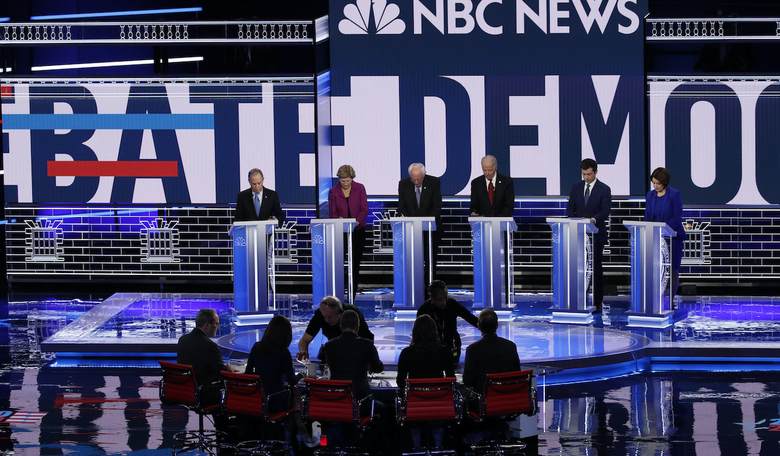
The definition of debate, as found in Merriam-Webster: Debate (noun), a contention by words or arguments, such as a regulated discussion of a proposition between two matched sides.
The definition of debate, as applied by the Democrat Party for 2028: Debate (noun), a show in which all participants must agree to a proposition before engaging at all.
CNN reports this morning that the Democrat Party plans to hold 12 debates in the run-up to its presidential primaries, starting in June 2027. 'Debates,' however, may be too generous a word. In order to qualify for the stage, candidates must first denounce the kind of fundraising that they, er, have employed enthusiastically in the past:
The Democratic National Committee announced Monday it will hold twelve debates for the next presidential primary starting in June — and is adding a significant new condition for candidates to participate.
Candidates will have to sign a pledge to denounce super PAC and so-called “dark money” spending in the primary, a win for progressives who have long pushed for the party to crack down on big money in politics.
The requirement adds another twist to a 2028 Democratic primary that is already expected to be crowded and competitive as the party looks to retake the White House. The DNC has already overhauled its lineup of early primary states, keeping South Carolina first but removing Iowa and adding New Mexico, Michigan and Virginia to the mix. ...
The biggest change, though, is what the DNC is calling its Fair Campaign Practices Pledge. Under the pledge, candidates who want to join DNC debates must designate a representative who can complain to the committee about spending by a 501(c)(4) nonprofit — a type of group that does not have to disclose its donors — or a super PAC, which can raise and spend unlimited amounts of money from individuals and corporations. If the DNC agrees that the spending violates the pledge, it will ask candidates to provide a statement to the DNC denouncing the spending.
The DNC will publish a tracker of complaints — and denunciations — on its website.
First off, this demand seems rather rich coming from a party with ties to some very wealthy benefactors. Democrats have screamed over Elon Musk's massive cash outlays in this midterm cycle – estimated at almost $500 million – while conveniently overlooking how little good it actually did Republicans, especially in Texas. That also overlooks just how much "ultra-wealthy" money gets spent for Democrats, as Kyle Becker pointed out in response to Sen. Alex Padilla (D-CA):
@SenAlexPadilla Short list of Dems' billionaire donors (recent contributions): • George & Alex Soros: ~$50–100M+ to Dem PACs • Michael Bloomberg: ~$84M • Reid Hoffman: ~$40M • Dustin Moskovitz: ~$18M • J.B. Pritzker: ~$24M • Tom Steyer: ~$250M+ multi-year • Chris Larsen: ~$20M
— Kyle Becker (@kylenabecker) November 19, 2026
Pritzker, by the way, is reportedly preparing to explore his own presidential aspirations. Will the DNC complain about the ultra-wealthy Pritzkers – the Hyatt hoteliers – buying an election or two in Illinois and possibly a presidential nomination in 2028? The DNC also fails to mention the now-defunct Arabella Advisors, a network of progressive billionaires who funded 'storefront' activist groups that astroturfed the hard-Left agenda for years. Nor do these progressive scolds mention Arabella's successor organization, the Sixteen Thirty Fund, which picked up where Arabella left off.
What they also don't mention is that this is entirely performative. These candidates might just as well sign denunciations of rainy days and Mondays. Super PACs operate independently from campaigns and political parties, and the "dark money" involved is legal as long as it doesn't violate laws against money laundering. It can come from foreign sources, unlike direct donations to candidates or political parties. In fact, candidates can use denunciations as an advantage when these super PACs cross the line on their messaging, while pointing out that neither the candidate nor the campaign has any control over their speech or spending.
This is the dodge that the DNC sets up with this prerequisite. A debate over whether these practices are corrosive or a method for free political speech by activists might not just be interesting, it would also force a discussion on how "campaign finance reform" created the conditions for super PACs and "dark money." The DNC wants to short-circuit that discussion by making access to the debate stage contingent on participating in a struggle session before entry that essentially inoculates Democrats from criticism over messaging funded by their own dark-money billionaire set:
A total of 82 billionaires (or more) are backing Harris. Forbes identified these 28 billionaires who donated $1 million toward groups supporting Harris through August: - Arthur Blank (Atlanta Falcons) - Michael Bloomberg (Bloomberg, former New York mayor) - Neil Bluhm (Real estate) - John Doerr (Kleiner Perkins) - Amy Goldman Fowler (New York real estate) - Avram Glazer (Tampa Bay Buccaneers) - Reid Hoffman (LinkedIn) - Robert Hale, Jr. (Granite Telecommunications) - Amos Hostetter, Jr. (Cable) - Bruce Karsh (Oaktree Capital Management) - Vinod Khosla (Khosla Ventures) - Seth Klarman (Baupost) - Henry Laufer (Renaissance Technologies) - Stephen Mandel, Jr. (Lone Pine Capital) - George Marcus (Marcus & Millichap) - Michael Moritz (Sequoia Capital) - Dustin Moskovitz (Facebook) - John Pritzker (Hyatt hotels) - Haim Saban (Fox Family Channel) - Sheryl Sandberg (Facebook) - Eric Schmidt (Google) - Lynn Schusterman (Samson Resources) - David Shaw (D.E. Shaw) - The late Jim Simons (Renaissance Technologies) - Gwendolyn Sontheim Meyer (Cargill) - Steven Spielberg (Hollywood director) - Thomas Steyer (Farallon Capital) - Pat Stryker (Stryker Corp.) The following 36 billionaires made between $50,000 and $999,999 in donations to groups supporting Harris through August, according to Forbes’ analysis of FEC data: - David Blitzer (Blackstone) - David Bonderman (TPG) - Edythe Broad (Eli and Edythe Broad Foundation) - Tory Burch (Tory Burch) - Rick Caruso (Los Angeles real estate) - James Chambers (Cox Enterprises) - Robert Clark (Clayco) - Barry Diller (IAC) - Dagmar Dolby (Dolby Laboratories) - Charles Ergen (DISH) - John Fish (Suffolk Construction) - Gordon Getty (Getty Oil) - James Goodnight (SAS) - Jonathan Gray (Blackstone) - Thomas Hagen (Erie Indemnity) - Reed Hastings (Netflix) - Elizabeth Johnson (Fidelity Investments) - Michael Krasny (Computer Discount Warehouse) - Chris Larsen (Ripple) - Marc Lasry (Avenue Capital Group) - Theodore Leonsis (Washington Capitals, Mystics and Wizards) - Daniel Och (Och-Ziff Capital Management) - Mark Pincus (Zynga) - Laurene Powell Jobs (Apple, gave about $900,000 to Harris Victory Fund last quarter) - Katharine Rayner (Cox Enterprises) - Stewart Resnick and Lynda Resnick(Wonderful Company) - John Sall (SAS) - Paul Sciarra (Pinterest) - George Soros (Soros Fund Management) - Jonathan Tisch and Laurie Tisch(Loews Corporation) - Todd Wagner (https://t.co/WDHMgKS8Ro) - Christy Walton (Walmart) - Elaine Wynn (Wynn Resorts) - Dirk Ziff (Ziff Davis).
— Squirrelknut (@Squirrelknut) November 20, 2026
The DNC isn't upset about money in elections. The DNC is butthurt over having competition in this cycle. Will their moderators ask candidates to denounce Reid Hoffman on stage during a televised debate for all of the "dark money" he pours into election cycles? How about the Pritzkers? Will one Democrat name Steven Spielberg and Dustin Moskovitz as Enemies of the People? How about George and Alex Soros?
Don't hold your breath. The DNC wants a performative struggle session, not an actual solution, which in this case would be the elimination of campaign finance limits and an end to tax deductions to PACs and super PACs. The DNC and its candidates want to offer cheap denunciations rather than put their money where their mouths are, almost literally.