
Alternate headline: Fraud plays out in Minnesota's Senate race in more ways than one.
Peggy Flanagan has already had to play defense as Tim Walz' top lieutenant in the administration that allowed $9 billion or more to flow to fraudsters among their allies in Somali ex-pat community. Flanagan has tried arguing that the fraud had nothing to do with her office, even while she posed with at least one accused fraudster (while wearing a hijab, no less).
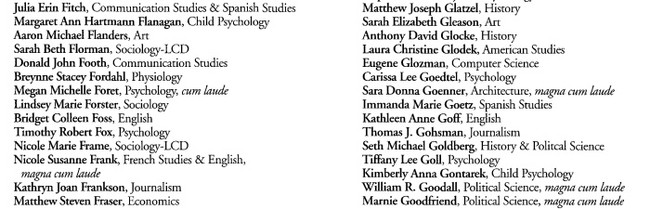
Now, however, Flanagan has been exposed as a fraud herself. The Wall Street Journal did some digging into the Lt. Gov.'s claim to have graduated as a Phi Beta Kappa, an argument Flanagan used to defend DEI policies in education. Flanagan graduated from the University of Minnesota in 2002, but a peek at the program from the ceremony shows no honors associated with Margaret Ann Hartmann Flanagan:
Peggy Flanagan said she “graduated Phi Beta Kappa” while arguing a decade ago for legislation to encourage greater teacher diversity in Minnesota’s public schools.
Now the state’s lieutenant governor and Democratic U.S. Senate nominee, Flanagan was a Minnesota House member when she said college teaching diversity transformed her from a high-school graduate with a 1.75 grade-point average to a University of Minnesota honors student.
“Everything changed, there was a switch, something clicked,” Flanagan said during a March 2016 legislative hearing. “I graduated Phi Beta Kappa because I saw myself reflected in my teacher and I saw myself reflected in my curriculum.”
A commencement program for Flanagan’s class of 2002 doesn’t list her as an honors student, although it did highlight those with GPAs of 3.5 or higher. The university’s current GPA threshold for Phi Beta Kappa is 3.65 for a senior.
Not only did Flanagan not qualify for Phi Beta Kappa, she didn't even graduate with honors. That undercuts her defense of DEI, unless one counts the ability to use it to fake success.
Speaking of fake, Flanagan's campaign blames poverty for the discrepancy. No, seriously:
“The lieutenant governor was nominated for Phi Beta Kappa, but like too many other students, she couldn’t afford the application fees to become a part of the honor society,” Alexandra Fetissoff, a campaign spokeswoman, said in a statement.
The current lifetime membership fee at the University of Minnesota is $99, although it was likely considerably less more than two decades ago. Many chapters also waive the fee or make other accommodations in cases of financial hardship.
That response doesn't explain the lack of honors mention in the program, either. If Flanagan qualified for Phi Beta Kappa, she would have an honors designation next to her name. The program explains the designations:
Honors designations-Honors graduates complete college and departmental honors requirements, including completing honors projects in their majors, with a minimum G.P.A of 3.5 for the last 60 credits of their undergraduate career. Students meeting these minimum requirements may graduate cum laude. Students graduating magna cum laude have a minimum G.P.A. of 3.66. Students graduating summa cum laude have a minimum G.P.A. of 3. 75 and have completed a summa thesis that has been approved by three readers, one of whom is outside the discipline of the major.
To qualify for PBK, Flanagan would have had to achieve at least a 3.65 GPA, which would have merited a cum laude designation in the program. Here's a screenshot from her listing:
 Flanagan graduated from college, which is certainly worth a brag or two. However, she did not merit honors, let alone Phi Beta Kappa membership. What was her GPA? The campaign isn't saying, which means it probably isn't high enough to support her argument for DEI policies.
Oh, and Flanagan also lied about being a double major, which is also apparent from the program listing:
Flanagan’s team also confirmed that the Democratic candidate did not receive a double major at college despite her state biography stating that she “earned her bachelor’s degree in American Indian studies and child psychology.”
Flanagan graduated with a child psychology major and a minor in American Indian studies, according to her campaign.
Again, that's a worthwhile accomplishment. Flanagan didn't have to lie about it, but she did and did so consistently as a way to push for discredited discriminatory practices in education. That's fraud, and it goes a long way to explaining why Flanagan and the Walz administration have been so comfortable with fraud in other contexts for the last several years.
Minnesota voters have an opportunity to deliver accountability for fraud in more than one context by electing Michele Tafoya rather than Peggy Flanagan, or as we can call her, Peggy Fraud-Again. And this may be why the DSCC is taking a pass on Minnesota in the final fortnight of the midterms.