



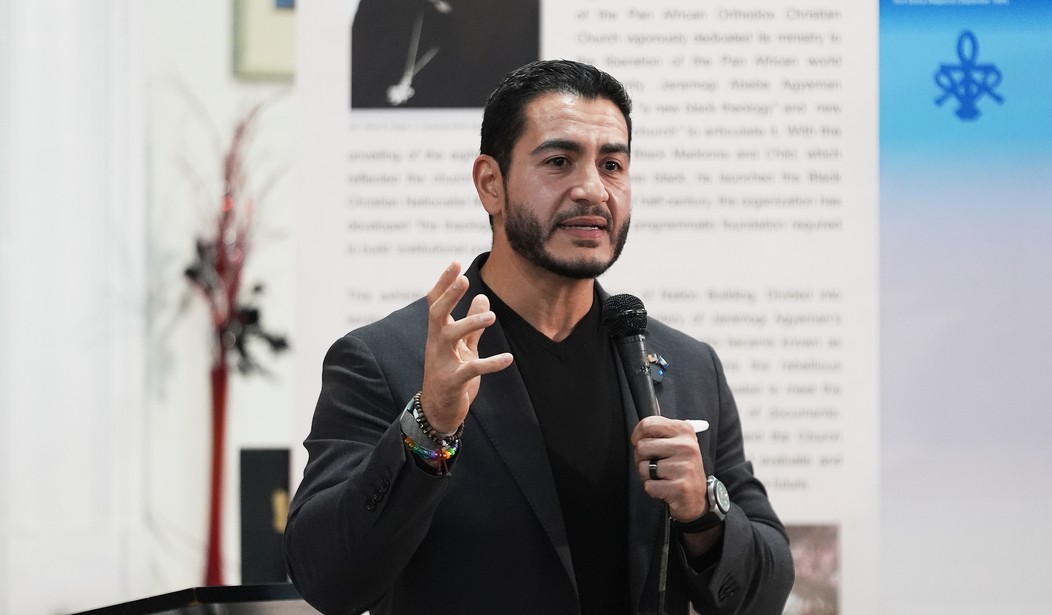
Tell me again how Abdul El-Sayed leads in the polls. I triple-dog dare you.
El-Sayed supposedly led the primary polls by as much as fifteen points before barely edging out Haley Stevens by a single point. Stevens won Detroit, thanks to disaffection from El-Sayed by black voters, who still tell focus-group testers that they're not enthusiastic about his candidacy. It's become such a problem that El-Sayed has asked Barack Obama to come to his rescue, apparently unaware that Obama tried to do the same for Hillary Clinton almost exactly ten years ago and came up short – while still being president at the time.
With 15 days to go before Election Day, RealClearPolling still shows El-Sayed ahead of Mike Rogers, but only by 2.6 points in their aggregate average. Is this accurate? Perhaps, but someone will have to explain how El-Sayed can be out in front while leaders of his own party are telling Democrats to leave that race blank on the ballot. David Kramer and Lon Johnson pitched abstention in a column at the Detroit News this weekend:
Supporting a nominee after a hard-fought primary is an act of party unity, not a surrender of principle. Democrats asked to set aside their differences for U.S. Senate candidate Abdul El-Sayed had every right to expect something in return: a commitment to earn their trust, address legitimate concerns and unite a party whose nomination he won with less than 50% of the vote.
He has failed that test. As a result, we will not vote for Abdul El-Sayed. Some may then conclude we, or other loyal Democrats, need to vote for a different party, but for many of us, leaving the ballot blank is an act of dignity.
Party unity does not require silence, and no nomination entitles anyone to our votes.
Who are Kramer and Johnson? The Detroit News bio explains:
David Kramer served in senior leadership roles for Michigan Democrats running for Senate. Lon Johnson is a former Chairman of the Michigan Democratic Party.
In other words, these two men have the history and heft to define what Democrats are, and what they are not. The two have not renounced their status as Democrats; in fact, they make clear that they intend to work inside the party to elect Democrats to every office. However, "support must be earned," and as Kramer and Johnson make clear, candidates have to represent the party's values to earn that support.
And the pair make clear that Hasan Piker does not represent those values:
The Democratic Socialists of America (DSA) and activists aligned with its movement are pushing Democrats toward ideological positions that threaten our broader electoral coalition. Although El-Sayed denies DSA membership, his relationships with prominent socialist activists raise a fundamental question: Will he challenge their most extreme positions or help make them the Democratic Party's new platform?
Consider Hasan Piker, who notoriously declared that America deserved 9/11 and whom El-Sayed welcomed into Michigan's political arena. Rejecting offensive statements means little if a candidate continues benefiting politically from those who make them.
It's not just Piker, either, but El-Sayed himself. His inability to recognize that Iran is a far greater threat than Israel dumbfounded both men and has no connection to either reality or true Democrat values, they argue:
During the Oct. 8 Senate debate, El-Sayed also declined to identify whether Iran or Israel posed the greater threat to America, dismissing the comparison as hypothetical. Such evasiveness is unacceptable given the Iranian regime's decades-long record of killing Americans, sponsoring terrorism and destabilizing the Middle East.
The entire essay is well worth reading in full. Nowhere in it do they make an argument for casting a vote for Mike Rogers, which seems a little mean-spirited, given Rogers' record of service to our country in both the FBI and in Congress. In this instance, though, it serves a purpose, as some Democrat voters might balk at the idea of voting for a Republican, especially with Orange Man Bad still on the campaign trail. The option to abstain may appeal far more and have essentially the same outcome.
And that may once again prompt the question of who exactly answers polls in Michigan in this cycle – and in Texas, Maine, Wisconsin, and other battlegrounds where radical Democrats hold inexplicable leads at RCP.
Editor’s Note: The 2026 Midterms will determine the fate of President Trump’s America First agenda. Republicans must maintain control of both chambers of Congress.
Help HotAir continue to report on the Democrats’ radicalism and inform voters as our nation faces a crossroads. Join HotAir VIP and use promo code FIGHT to receive 60% off your membership.



Join the Conversation
VIP members get the ability to comment on articles.