This morning’s Gospel reading is Matthew 13:44–52:
Jesus said to his disciples:
“The kingdom of heaven is like a treasure buried in a field, which a person finds and hides again, and out of joy goes and sells all that he has and buys that field. Again, the kingdom of heaven is like a merchant searching for fine pearls. When he finds a pearl of great price, he goes and sells all that he has and buys it. Again, the kingdom of heaven is like a net thrown into the sea, which collects fish of every kind. When it is full they haul it ashore and sit down to put what is good into buckets. What is bad they throw away. Thus it will be at the end of the age. The angels will go out and separate the wicked from the righteous and throw them into the fiery furnace, where there will be wailing and grinding of teeth.
“Do you understand all these things?” They answered, “Yes.” And he replied, “Then every scribe who has been instructed in the kingdom of heaven is like the head of a household who brings from his storeroom both the new and the old.”
"Make new friends but keep the old," the lyrics of an old song tell us, "one is silver, the other is gold." When we encounter the new, we assume that it eclipses the old. Or, at times, we refuse to open our eyes to the new in our desperation to cling to what we know. Both of these impulses will prevent us from growth, wisdom, and understanding, and Jesus knew to warn His disciples of these pitfalls.
The attention to today's Gospel reading will fall mainly on the analogy comparing the Word of God to a pearl of great price, and rightfully so, as it is rich in meaning and subtlety. Jesus' more direct teaching on the culling of the fish at the end of the age will likely get focus as a real warning to the choices we make. And again, this is also wisdom, as Jesus repeated these teachings during His ministry, clearly wanting to impress disciples of all ages as to the import of their decisions and actions.
Instead, we should pay heed to Jesus' last comment about the scribes and their role in His kingdom. At the time, the scribes and Pharisees of the temple had made themselves opponents of Jesus, who clung to the old interpretations and literal applications of scripture. They refused to open themselves to the possibility of a new Incarnation of the Word and a much different form of messiah than their interpretations allowed. That was hardly a new impulse in the history of God's chosen people; they had routinely ignored prophets who warned them of faulty interpretations of the Law, not to mention flat-out rejection of it, for most of their history. Even the prophets whose teachings we read today were at times rejected and attacked for their gloomy prophecies.
At the same time, though, Jesus warns His disciples and us that the wisdom of the prophets remains. Our first reading today from 1 Kings recalls the gift of wisdom to Solomon from the Lord, who had asked for the knowledge that Adam and Eve had arrogantly assumed in the Garden: the wisdom to fully know right from wrong and act in judgment of it. Solomon did not act as Adam and Eve did, grasping at the Lord's authority so as to eclipse Him, but to ask for a grant of authority to wield it in the Lord's name and within His will.
This wisdom still applies to our lives today, as does the entirety of what preceded Jesus' mission as the incarnate Lord. So does the wisdom expressed by Jeremiah, Isaiah, Hosea, and all of the prophets, all the way through John the Baptist. Jesus declared at the Sermon on the Mount to His disciples (Matthew 5:17-20):
"Do not think that I have come to abolish the Law or the Prophets; I have not come to abolish them but to fulfill them. For truly I tell you, until heaven and earth disappear, not the smallest letter, not the least stroke of a pen, will by any means disappear from the Law until everything is accomplished. Therefore anyone who sets aside one of the least of these commands and teaches others accordingly will be called least in the kingdom of heaven, but whoever practices and teaches these commands will be called great in the kingdom of heaven. For I tell you that unless your righteousness surpasses that of the Pharisees and the teachers of the law, you will certainly not enter the kingdom of heaven.["]
Jesus did not come to erase what came before; He came to integrate it while providing a new understanding that would lead us to salvation, if we chose it.
Why is this teaching important to us now, two millennia later? We have the same failing as our ancestors in faith did. We either reject the new in favor of the old, or the old in favor of the new. In the church, the latter has been a much more pernicious failing, to the point of actual heresy. The Dualists and the Cathars interpreted the Old Testament as pertaining to a different God than the one presented in the New Testament, and the same issue arose with the Gnostics in perhaps less explicit terms. Modern churches will either downplay or ignore the Old Testament in favor of the New, preferring to focus on the Gospels and Jesus' teachings alone. And to be fair, the Lord presented through Jesus and in the epistles feels safer and more comfortable than the Lord who allowed His people to suffer the consequences of their own betrayals in the Old Testament.
That, however, is heresy in itself. God is unchanging; it is our interpretation of the Lord that changes, grows, and at times, fails. God is ever constant, filled with love for His children so much that He sends a constant stream of prophets attempting to provide them wisdom, just as the Lord anointed Solomon. God finally sent His only Son to die for us after His mission to call all people to return to Him, knowing we could never pay the full penalty of the blood covenant He made with Abraham for eternal salvation. To discard all of the prophets and the history leading up to Jesus' salvific mission would be to discard the covenant and the eternal love the Father bore for us through millennia of rejection and rebellion.
And that would negate Jesus' mission altogether. God has not moved because God cannot be moved; He is constant and eternal. Jesus came to the world to move us back toward the Father, not to create a new Father so that we could engage in false amnesia about who and what we are. What else could Jesus do? He is the Word Incarnate, whose voice can be heard all through the Old Testament, calling to the people to listen to the wisdom of His Father. In Jesus, the scriptures are integrated, just as through Jesus, we can be integrated into the Trinitarian life of the Father.
We can only be integrated if we bring from the storeroom both the old and the new, in which we can see that it is all the same: the Word of the Lord. It is only our understandings that are old and renewed through Him.
Previous reflections on these readings:
- Selling out and buying in: Sunday reflection (2020 and 2023)
- Sunday reflection: Matthew 13:44–52 (2017)
- Sunday reflection: Matthew 13:44–52 (2014)
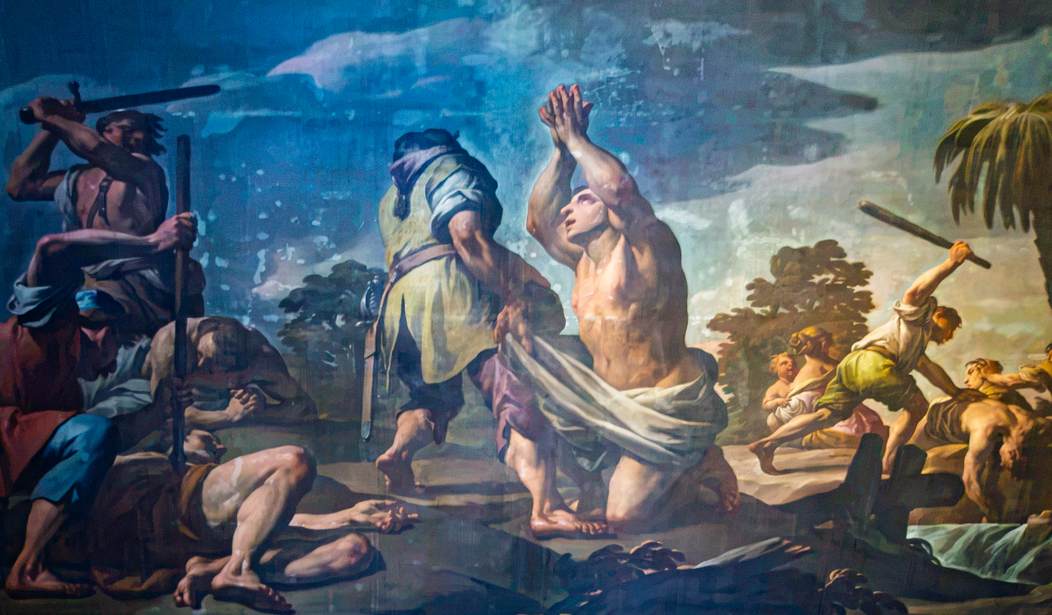
The front page image is Il Battesimo di Sangue (The Baptism of Blood) by Italian artist Francesco Trevisani, dating from around 1740. On display in the Basilica of St. Mary of the Angels and the Martyrs in Rome. Photo from Ed Morrissey's personal collection. (I just discovered this in my photos; I may have more to share later.)
“Sunday Reflection” is a regular feature that looks at the specific readings used in today’s Mass in Catholic parishes around the world. The reflection represents only my own point of view, intended to help prepare myself for the Lord’s day and perhaps spark a meaningful discussion. Previous Sunday Reflections can be found here.
Editor's Note: Our Sunday Reflections are free to all readers, but our VIP members help keep this platform going for everyone. Join the effort by using the promo code FIGHT to get 60% off new memberships and upgrades to VIP Gold and VIP Platinum!












Join the conversation as a VIP Member