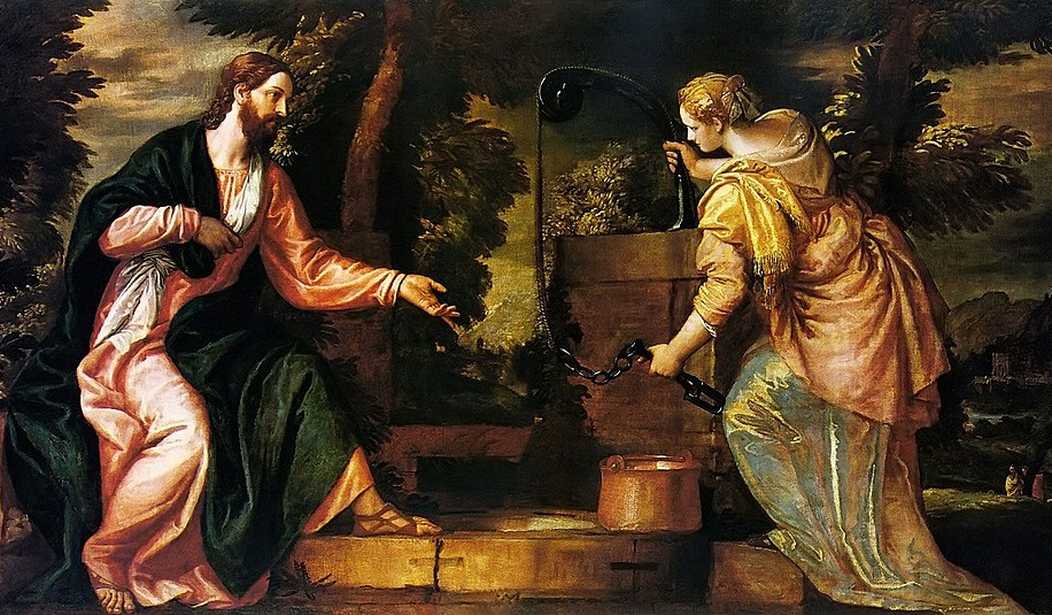
This morning’s Gospel reading is John 4:5–42:
Jesus came to a town of Samaria called Sychar, near the plot of land that Jacob had given to his son Joseph. Jacob’s well was there. Jesus, tired from his journey, sat down there at the well. It was about noon.
A woman of Samaria came to draw water. Jesus said to her, “Give me a drink.” His disciples had gone into the town to buy food. The Samaritan woman said to him, “How can you, a Jew, ask me, a Samaritan woman, for a drink?” —For Jews use nothing in common with Samaritans.— Jesus answered and said to her, “If you knew the gift of God and who is saying to you, ‘Give me a drink,’ you would have asked him and he would have given you living water.” The woman said to him, “Sir, you do not even have a bucket and the cistern is deep; where then can you get this living water? Are you greater than our father Jacob, who gave us this cistern and drank from it himself with his children and his flocks?” Jesus answered and said to her, “Everyone who drinks this water will be thirsty again; but whoever drinks the water I shall give will never thirst; the water I shall give will become in him a spring of water welling up to eternal life.” The woman said to him, “Sir, give me this water, so that I may not be thirsty or have to keep coming here to draw water.”
Jesus said to her, “Go call your husband and come back.” The woman answered and said to him, “I do not have a husband.” Jesus answered her, “You are right in saying, ‘I do not have a husband.’ For you have had five husbands, and the one you have now is not your husband. What you have said is true.” The woman said to him, “Sir, I can see that you are a prophet. Our ancestors worshiped on this mountain; but you people say that the place to worship is in Jerusalem.” Jesus said to her, “Believe me, woman, the hour is coming when you will worship the Father neither on this mountain nor in Jerusalem. You people worship what you do not understand; we worship what we understand, because salvation is from the Jews. But the hour is coming, and is now here, when true worshipers will worship the Father in Spirit and truth; and indeed the Father seeks such people to worship him. God is Spirit, and those who worship him must worship in Spirit and truth.” The woman said to him, “I know that the Messiah is coming, the one called the Christ; when he comes, he will tell us everything.” Jesus said to her, “I am he, the one speaking with you.”
At that moment his disciples returned, and were amazed that he was talking with a woman, but still no one said, “What are you looking for?” or “Why are you talking with her?” The woman left her water jar and went into the town and said to the people, “Come see a man who told me everything I have done. Could he possibly be the Christ?” They went out of the town and came to him. Meanwhile, the disciples urged him, “Rabbi, eat.” But he said to them, “I have food to eat of which you do not know.” So the disciples said to one another, “Could someone have brought him something to eat?” Jesus said to them, “My food is to do the will of the one who sent me and to finish his work. Do you not say, ‘In four months the harvest will be here’? I tell you, look up and see the fields ripe for the harvest. The reaper is already receiving payment and gathering crops for eternal life, so that the sower and reaper can rejoice together. For here the saying is verified that ‘One sows and another reaps.’ I sent you to reap what you have not worked for; others have done the work, and you are sharing the fruits of their work.”
Many of the Samaritans of that town began to believe in him because of the word of the woman who testified, “He told me everything I have done.” When the Samaritans came to him, they invited him to stay with them; and he stayed there two days. Many more began to believe in him because of his word, and they said to the woman, “We no longer believe because of your word; for we have heard for ourselves, and we know that this is truly the savior of the world.”
O let all who thirst, let them come to the water.
And let all who have nothing, let them come to the Lord:
Without money, without price.
Why should you pay the price, except for the Lord?
This is the opening verse of one of the lovely hymns written by Fr. John Foley, an American Jesuit priest whose compositions have become staples in Catholic liturgies over the past fifty years. Fr. Foley has also written "One Bread, One Body" (another favorite of mine), "The Cry of the Poor," and "Earthen Vessels," among others. We sang "Come to the Water" last night in our Mass, a particularly apt choice for the Gospel reading.
Our first reading from Exodus also connects to Fr. Foley's first verse. Moses has led the Israelites out of Egypt and has crossed the Red Sea, and the nation has been fed manna and quail through the Lord's intervention. Shortly afterward, though, water had begun to run short, and the Israelites again started to rebel against Moses. Moses appealed to the Lord, who instructed him to strike a rock with his staff:
The LORD answered Moses, “Go over there in front of the people, along with some of the elders of Israel, holding in your hand, as you go, the staff with which you struck the river. I will be standing there in front of you on the rock in Horeb. Strike the rock, and the water will flow from it for the people to drink.” This Moses did, in the presence of the elders of Israel. The place was called Massah and Meribah, because the Israelites quarreled there and tested the LORD, saying, “Is the LORD in our midst or not?”
The Israelites had lost faith in the Lord, despite His deliverance from Egypt, at the Red Sea, and the food He had provided. It took water to restore their lives in faith.
This offers an interesting parallel to the Samaritan woman who talks with Jesus at the well. The Judeans saw the Samaritans as lost in faith, the remnants of the Northern Kingdom who had intermarried with their Assyrian conquerors and turned heretical. The Samaritans in turn considered the Judeans as the heretics, and a great deal of enmity had arisen between them, so much so that any contact was considered socially impermissible – perhaps especially between a rabbi and a Samaritan woman. The Gospel reading describes the disciples as "amazed" at Jesus' interaction, but from the responses given in the text, dismayed may be more accurate.
This misses the point, however. The Lord offered the water to the Israelites not because they were strong in faith but because their faith was dying of thirst, literally in that instance. The Samaritan woman's sins have all but destroyed her connection to faith as well, and her errors have left her wandering in a dry wilderness. He did not come to settle a sectarian squabble among brothers, but to lead all to salvation by offering them the water of eternal life.
Jesus opens her to receiving this water by first asking her for water from the well, and then teaches her that water in this world is just a means of physical sustenance. Only the water of the Word, provided by Him, has the power to sustain true life. Jesus then provides her with the Word when she asks him sincerely for it, and in the process exposes then forgives her sins.
Note well how the Samaritan woman responds. She asks Jesus about the Messiah and His deliverance through faith, and Jesus reveals to her that He is the Messiah. She asks the question asked by the Israelites at Massah and Meribah: "Is the Lord in our midst or not?" Having received the water, she receives the answer, just as the Israelites did in the desert. The Samaritan woman immediately grasps the joy of His love and cannot contain herself in proclaiming it to all she knows, it so consumes her heart in that moment.
In this exchange, we can see that Jesus provides the water of life for all who thirst and will accept it. It is not reserved for the disciples, and not only for the Israelites. Even those who have lived in sin and heresy can receive it and revive their faith in the Lord simply by accepting it from Jesus. Or, as Father Foley puts it in his final verse:
And let all the poor, let them come to the water.
Bring the ones who are laden, bring them all to the Lord:
Bring the children without might.
Easy the load and light: come to the Lord.
Let us all come to the water – and then embrace the joy of salvation as the Samaritan women did.
Note: To set the mood, I offer this lovely rendition of Foley's hymn, arranged in full harmonies.
Previous reflections on these readings:
The front page image is "Christ and the Woman of Samaria" by Paolo Veronese, c. 1585. On display at the Kunsthistorisches Museum. Via Wikimedia Commons.
“Sunday Reflection” is a regular feature that looks at the specific readings used in today’s Mass in Catholic parishes around the world. The reflection represents only my own point of view, intended to help prepare myself for the Lord’s day and perhaps spark a meaningful discussion. Previous Sunday Reflections can be found here.
Editor's Note: Our Sunday Reflections are free to all readers, but our VIP members help keep this platform going for everyone. Join the effort by using the promo code FIGHT to get 60% off new memberships and upgrades to VIP Gold and VIP Platinum!












Join the conversation as a VIP Member