





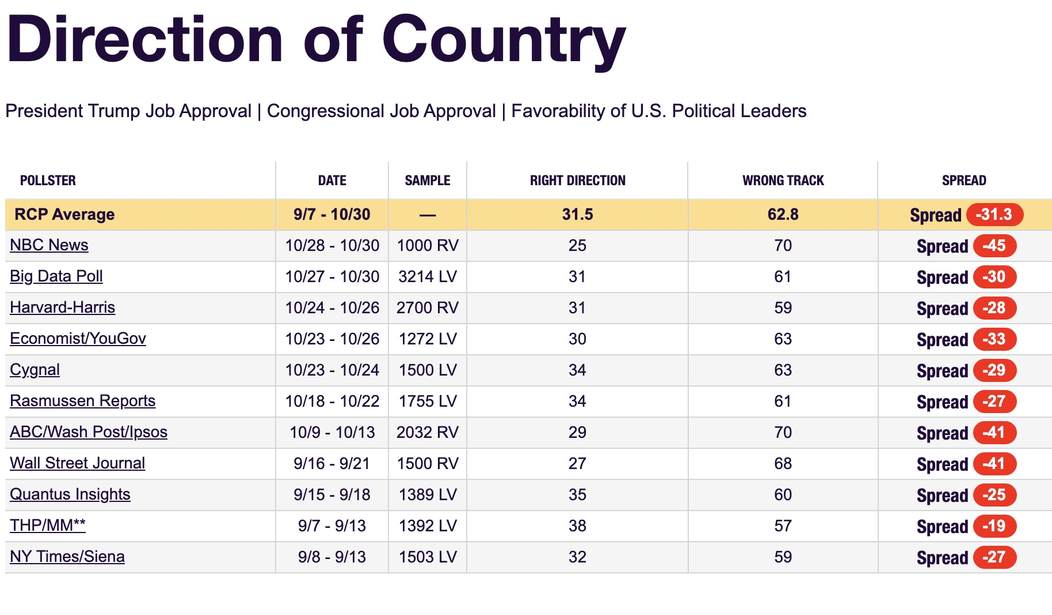
I'm going to stay away from the whole "polls are rigged" accusation because it's pointless to make that case.
Polls don't need to be rigged to be very wrong, and there are plenty of reasons to believe that the polls are unreliable without getting into the question of whether they are motivated by animus toward Republicans, so why go there? And for all we know, this year the polls could actually overcorrect for prior failures, since being too far off too often is bad for business, and as much as they may hate Republicans, pollsters still want to make money.
With that out of the way, let's get to the meat of the problem: whatever the error bars say (+/- 3.5 % or whatever), the reality is that polls are little more than wild-a$$ guesses this year.
As I have written before, the basic problem with polling in this environment is that there is no such thing as a random sample anymore, and random samples are the bedrock of polling methodology.
A friend of mine who is a retired political scientist whose entire career was focused on American politics sent along this analysis from Austin Campbell that describes the problem with the recent Texas poll:
No, it was not; this is why you don't trust the polls this cycle. This poll is saying the weather outside is sixty degrees, plus or minus eighty degrees. Let's talk about what is happening here, using the TX one as an example: The raw sample was 1,115 Harris voters to 804 Trump voters, about Harris +14.5. In a state that went to Trump by double digits. No non-response rate was published here, but based on past surveys, it's also likely that the Republicans hung up more, refused to answer more, refused to finish polls more, and thus the ones you get are the sub-sample who actually would talk to you. Then to get to "R+16", they have to weight on demographics, a modeled "party score" from the voter file and 2024 vote. The party-score targets aren't disclosed, and nothing says they weighted to the early vote. So what does this mean? You got a base sample over 25 points off the actual electorate, you have a severe non-response problem on the R (and probably I) side, you assume the Rs willing to talk to a pollster represent the ones who don't, and then you scale it up on your model. When you finally report it all, you report an error band as though you had a representative sample in the first place. You don't. The actually error boundaries here are massive. The TX race is probably anywhere from Talarico +4 to Paxton +10, and anyone who thinks they know the actual number is insane. We simply do not have a basis to conclude we know what voters think.
— Austin Campbell (@austincampbell) November 1, 2026
No, it was not; this is why you don't trust the polls this cycle. This poll is saying the weather outside is sixty degrees, plus or minus eighty degrees.
Let's talk about what is happening here, using the TX one as an example:
The raw sample was 1,115 Harris voters to 804 Trump voters, about Harris +14.5. In a state that went to Trump by double digits.
No non-response rate was published here, but based on past surveys, it's also likely that the Republicans hung up more, refused to answer more, refused to finish polls more, and thus the ones you get are the sub-sample who actually would talk to you.
Then to get to "R+16", they have to weight on demographics, a modeled "party score" from the voter file and 2024 vote. The party-score targets aren't disclosed, and nothing says they weighted to the early vote.
So what does this mean?
You got a base sample over 25 points off the actual electorate, you have a severe non-response problem on the R (and probably I) side, you assume the Rs willing to talk to a pollster represent the ones who don't, and then you scale it up on your model.
When you finally report it all, you report an error band as though you had a representative sample in the first place. You don't.
The actually error boundaries here are massive. The TX race is probably anywhere from Talarico +4 to Paxton +10, and anyone who thinks they know the actual number is insane.
We simply do not have a basis to conclude we know what voters think.
Pollsters know their samples aren't random, so they apply weights to make the sample look more like what they THINK the electorate should look like. But the differences between people who choose to respond to polls and those who refuse are anything but random, and they know that too.
Their corrections, in other words, are basically guesses, and are worth about as much as guesses made by any politically savvy pundit who doesn't have access to any poll at all. They are not exactly worthless, of course. These people are quite savvy and likely better at guessing than average, and their data isn't worthless for gauging the mood of people who answer the polls; it just means the error bars aren't as wide as they might be.
The data isn't junk; it just doesn't tell you what you think it should. What I get out of it is that Democrats are highly motivated, and if you combine that with my gut observation that Republicans are less so, you'd guess that Democrats will likely have a good year.
OK, but that isn't POLLING.
Ted Cruz on his podcast described the problem and the peril Republicans are in:
Sen. Ted Cruz (R-Texas) is warning that Republicans could lose as many as eight Senate seats in the midterm elections and get swept in all of the statewide Texas races, including the Senate contest between Republican Ken Paxton and Democrat James Talarico, if the GOP has a bad day on Nov. 3.
“The election is just a few days away, and all across the country there are Senate races that are incredibly close. There are eight to 10 Senate races across the country that are basically tied,” Cruz said on a Friday episode of his podcast, “The Verdict with Ted Cruz.”
“If we have a good night on Election Day, we could have a fantastic result. We could end up with 53 Republicans in the Senate. We could end up growing our majority in the Senate,” he said.
But he warned “if we have a bad day” Republicans “could wake up the day after Election Day, instead of 53 Republicans, with 45.”
“That big a delta is at play,” Cruz said after traveling to Georgia, Texas, South Carolina, North Carolina, Michigan and Iowa to campaign for GOP candidates.
If you boil that down, what Cruz is saying strikes me as both correct and unenlightening about what will happen tomorrow night. If Republicans show up, it could be a decent night; if not, Republicans could get killed because Democrats most certainly will, which is what those polls really tell us. Democrats are eager to stick it to Republicans.
🚨Scott's Scoreboard (Nov 2 Morning update) ✅Senate: 47 Safe/Likely D, 46 Safe/Likely R ✅Of 7 competitive Races, 5 Lean D and 2 are Tossups ✅Tossups are IA and KS ✅ME, AK, OH, TX and MI lean D ✅D's have 65% chance of winning Senate ✅House: 228 Safe/Like D, 194 Safe/Likely R ✅FINAL UPDATE at 9:00 pm Eastern tonight ✅On election night, we will update likely outcome and odds as races are called. https://t.co/CxQBh6T0IK
— Scott Rasmussen (@ScottWRasmussen) November 2, 2026
🚨Scott's Scoreboard (Nov 2 Morning update)
✅Senate: 47 Safe/Likely D, 46 Safe/Likely R
✅Of 7 competitive Races, 5 Lean D and 2 are Tossups
✅Tossups are IA and KS
✅ME, AK, OH, TX and MI lean D
✅D's have 65% chance of winning Senate
✅House: 228 Safe/Like D, 194 Safe/Likely R
✅FINAL UPDATE at 9:00 pm Eastern tonight
✅On election night, we will update likely outcome and odds as races are called.
https://scottsscoreboard.com
My own guesses lean toward where Scott Rasmussen has the races, but I don't have any idea how he is weighting his models either. One thing we know is that each pollster's methodology differs wildly. The New York Times polls have Democrats with a blowout, which is certainly plausible, while others have races right on the razor's edge.
@Nate_Cohn Final NYT polls in 2024. 🤷♂️ https://t.co/YXanA1hu2k
— L A R R Y (@LarryOConnor) November 2, 2026
Which is the other thing you should keep in mind. Even a perfect poll with a random sample has a significant margin of error, so a race with a Democrat 3.5 percent ahead and a 3.5 percent margin of error is telling you the race is tied, as far as they can tell. The race might not be tied, of course, but the poll can't tell you much of value. Which is why people assemble polls of polls, or poll aggregations. The idea is that errors will cancel out.
But will they? Probably not in an environment where samples aren't random.
The bottom line is that we have to revert to our guts, which is not the same as saying our hopes, which often influence our gut. And today, my gut says I have no clue.
Editor’s Note: Republicans are fighting for election integrity by requiring proper identification to vote. It's common sense, yet Democrats are spreading lies about the impact of such a measure.
Help us continue to call out these lies by joining HotAir VIP and using promo code FIGHT to receive 60% off your membership.


Join the Conversation
VIP members get the ability to comment on articles.