




Well, this is awkward for the anti-Israel crowd. A state they characterize as a Nazi-style genocidal regime just saw record Arab turnout, and the Arab parties hold the key to who will likely run Israel's government.
Bottom line up front: the polls had predicted that Prime Minister Netanyahu was in deep political trouble and would lose his governing coalition to a united left-wing one.
Netanyahu's bloc lost a significant number of seats, according to the current but incomplete vote count, but the left-wing opposition didn't gain a governing majority for one major reason: record turnout among Arab Israeli citizens, who will hold a record number of Knesset seats.
The supposed victims of an Israeli "genocide," Arabs, hold the current balance of power in Israel because, as citizens, they turned out in a much higher proportion than anybody expected. In the supposed "apartheid" state, Arab turnout was 75 percent, by far the highest on record. The polls were so far off because Arabs participated at a much higher rate than anticipated.
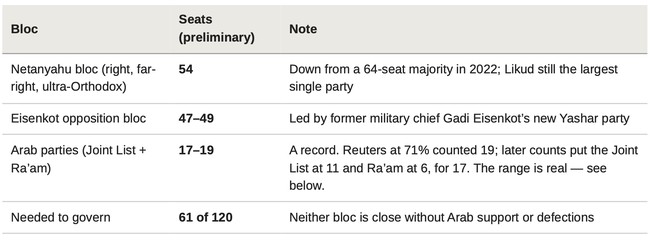 Unfortunately, it's too early to know how the final numbers will settle out. The remaining ballots to count are from military voters on deployment and others who couldn't make it to the polls, and it's hard to predict how they will shake out, given that Israel has a conscript military whose demographics more closely reflect Israel as a whole than an all-volunteer army. Their votes could swing the number of seats significantly, but that's a slim reed for either party.
Netanyahu is nearly as polarizing in Israel as he is in the United States, so it's not shocking that the election results weren't a full-throated endorsement of his governing style. He's been in and out of power for 30 years, beloved and hated, depending on whom you ask. He is certainly no favorite of the Arab minority, many of whom refuse to recognize the right of Israel to exist or even have Hamas sympathies (and many of whom don't; Arab parties have participated in governing coalitions and hold civil service and judicial positions, and have even voluntarily participated in the military, despite being exempt from the draft). An Arab member serves on the Israeli Supreme Court.
If Arabs were willing to meet a few conditions, the left-wing coalition could include them in what would be a governing coalition, but the parties refuse to recognize Israel as a Jewish state and refuse to condemn Hamas, although they do reject the methods used by the terrorist group on October 7. If they met those conditions, as some parties have in the past, they could help form a government now. The refusal of some members of the Arab coalition, and of some in the left-coalition, make that unlikely.
As exit polls showed Netanyahu and Eisenkot falling short of a majority, both leaders addressed supporters, trying to claim the night and shape a narrative of victory.
Netanyahu, speaking at the Likud headquarters in Jerusalem, thanked voters for what he called a renewed vote of confidence. But he stopped short of declaring outright victory.
“Two things became clear tonight: Likud is the largest party in Israel. There is no dispute about that,” he said. “And the second thing is that the right-wing bloc has a clear, decisive majority among the Zionist and Jewish public.”
“We must establish a strong national right-wing government,” Netanyahu continued. “Israel must not be endangered with a government that relies on anti-Zionist Arab parties that oppose our very existence, that see Hamas as a charity organization, that calls our soldiers war criminals.”
Eisenkot also did not declare victory as he spoke at his election headquarters in Tel Aviv. But he did say that Israel voted against Netanyahu.
Supporters react after polls closed at the Yashar party headquarters in Tel Aviv, Israel, on Tuesday, October 27, 2026.
“We have made history! The public has voted for change. The coalition of failure has lost the people’s trust,” he said. “The Israeli public has voted against Netanyahu continuing to serve as prime minister of Israel.”
Eisenkot, who was once Israel’s top general and lost a son fighting in Gaza, said that “a worthy leader would accept the people’s vote of no confidence and announce his retirement from political life today.”
The leader of the opposition, former General Eisenkot, set terms for any coalition partner: recognize Israel as a Jewish and democratic state, accept the values of the Declaration of Independence, accept an obligation of service (Arab citizens are currently exempt from conscription), and recognize Hamas as a terrorist organization that must be dismantled. He has said he sees no Arab party meeting those principles.
Arab voters turned out in record numbers, but a significant enough fraction of them refuse to condemn Hamas that they are forfeiting their opportunity to help govern. The irony is thick, because they helped keep Netanyahu afloat despite his losing many seats in the Knesset.
Israeli politics are Byzantine, and majorities in parliament are cobbled together by creating voting blocs of disparate parties; the Arabs could, so they choose, be the keystone to a ruling coalition that opposes Netanyahu with the passion equivalent to the power of a supernova; they have chosen not to do so, despite participation in the process at record rates.
It's a bizarre situation all around, as is befitting Israeli politics.
The one indisputable result, though, is that this election proved that Israeli Arabs are treated as full citizens with all the rights of Jews, and fewer actual responsibilities (they are exempt from military service requirements). They can and have participated in ruling coalitions in the past, and have chosen not to, despite having the opportunity to boot Netanyahu.
The Arab coalition could change its mind if its determination to oust Netanyahu exceeds the commitments that some parties within it have to rejecting Israel as a legitimately Jewish state. Never say never in Israeli politics, which makes Italy's look almost sane.
Late on election night, Mansour Abbas was asked about the conditions Gadi Eisenkot had set for working with Arab parties. His reply went to a more immediate problem: was there a government to be formed in the first place?
In the Channel 16 interview, the Ra’am leader put the arithmetic before the negotiations. First establish whether a government is viable, then discuss the terms. With the television projections pointing in different directions, there was a practical reason for that sequence. Abbas was assessing the possibilities available to his party and its voters. He might have leverage. He might discover that the final results left him with very little.
Israel’s Arab citizens are often discussed abroad as evidence in somebody else’s case. Their own political arguments receive less attention. They are invoked as evidence of Israeli democracy, or described through the discrimination they face. Meanwhile, their parties are debating how to exercise influence, what to demand, and how much compromise their supporters will accept.
Some of those choices have already changed Israeli history. Ra’am participated in the Bennett-Lapid coalition formed in 2021, helping sustain a government led initially by a prime minister from the Israeli right. This election could again put Arab parties near the center of coalition negotiations. Three broadcasters projected Netanyahu’s bloc short of a majority; Channel 14’s updated projection put it above one. These remain projections, not the official result.
Both sides — the right-leaning coalition and the left-wing one — include extremist parties that hold their partners hostage, complicating government formation and deepening polarization by making compromise difficult. That's a defect in the voting rules because they require proportional representation. Without it, the Likud-led government would probably moderate a bit, the Arabs would probably moderate a bit, and the left would probably moderate a bit, but the rules are the rules.
Eisenkot set four conditions for prospective coalition partners that the Arab parties would be unlikely to meet. His camp will now have to confront the consequences of those conditions: a majority for replacing Netanyahu may exist on paper without being available around the cabinet table.
Even a willingness to rely on Mansour Abbas’s Ra’am party would not, on the figures emerging Tuesday night, necessarily close the gap. Support from the Joint List would raise a further set of political obstacles.
The Arab parties, meanwhile, have voters and demands of their own. They cannot simply be penciled into someone else’s coalition arithmetic as though their only function were to provide the missing seats.
Their projected gains came as a result of a strong determination to ensure that another right-wing government does not emerge.
But helping to deny the outgoing coalition a majority and helping to install its replacement are two different achievements. The first appears within reach. The second will depend on negotiations and decisions still to come.
Another route for Eisenkot would be to bring in the two haredi (ultra-Orthodox) parties, projected together to win 12 seats.
That could provide a majority. It would also give those parties considerable leverage over a government whose prospective partners have promised meaningful changes to haredi conscription.
The difficulty is obvious. Bringing the haredi parties into the government might solve the coalition arithmetic while making one of its central policy commitments considerably harder to fulfill.
There is also an option that jumps off the page: a government comprising Likud, Yashar, Naftali Bennett’s B’Yachad, and Yisrael Beytenu.
On the projected figures, those parties would together have 67 seats, without the haredi parties, the Arab parties, or the parties on the hard-right (Otzma Yehudit and the Religious Zionist Party) or the hard-left (the Democrats).
Numerically straightforward. Politically, anything but.
If Netanyahu remains at Likud’s helm, such a government would require his opponents to abandon their promises not to serve under him. It would also require agreement on who leads and on what terms.
A coalition that looks doable on paper is anything in real life. That is the central problem emerging from Tuesday’s exit polls.
As it is the results show that the Arabs can have a say if they choose to. As it is, Netanyahu will likely remain in power until the next election if the Arabs hold out. If a permanent government can't form, the election will come next year, and it's unclear whether the record turnout will be repeated. As likely as not, Netanyahu will survive the next election, and if so, the Arab voting bloc will have made that possible.
Editor’s Note: Every single day, here at HotAir, we stand up and FIGHT, FIGHT, FIGHT against the radical Left and deliver the conservative reporting our readers deserve.
Help us continue to tell the truth about the Trump administration and its successes. Join HotAir VIP and use promo code FIGHT to receive 60% off your membership.