





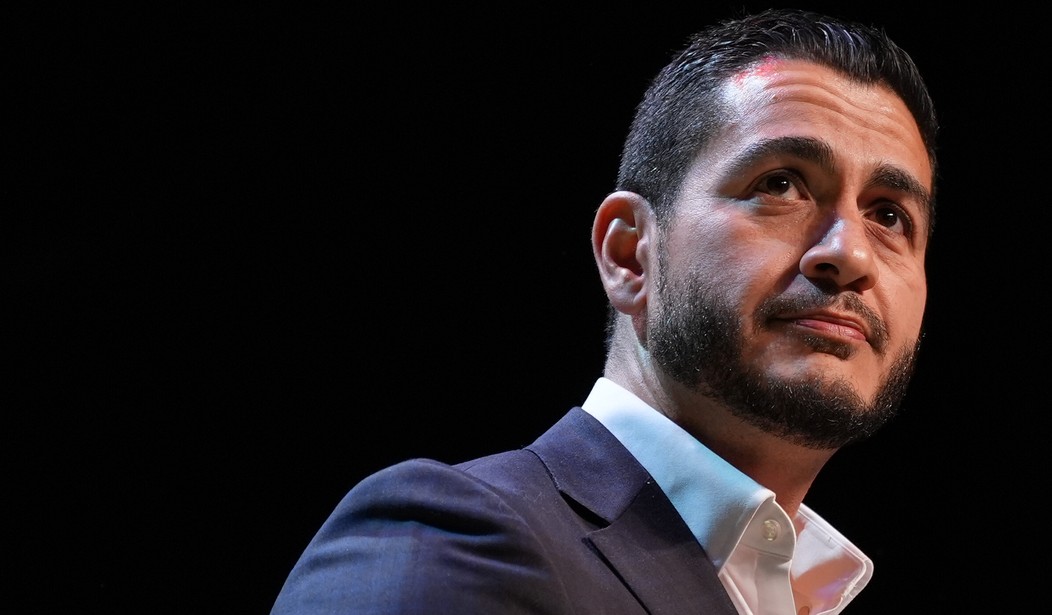
Yesterday I took a stab at why the pollsters were so far off on the Michigan Senate race. I think it was a pretty good first stab at explaining the issue, and no doubt there will be a lot of focus on the issue by people more competent than I to explain how the pollsters got things so wrong.
So I asked my friend-through-X, Scott Rasmussen, what he thought, and he was kind enough to give some insight into the issue.
First, let's look at the magnitude of the problem:
Emerson had Sayed winning whites 62-32 (Sayed+30)
— Latinx Adjacent Doctor PhD (@TonerousHyus) August 5, 2026
It appears he won them a lot closer to 5% margins. Pollsters cannot sample non college whites to save their lives and even their college samples are often libsh*ted https://t.co/MIX4FlG4if
The polls weren't just off by a little; they missed the result by double digits. And it was everybody, so this wasn't an Ann Selzer-type miss as happened in Iowa in 2024. The scale of that miss led to her retirement, but you can be certain that none of these pollsters will hang their heads in shame and quit.
"But Paul it was only 2 polls" Nah, it was all of them. pic.twitter.com/ZAt2O3Tj4J
— Paul (@WomanDefiner) August 5, 2026
I actually kept an eye on Polymarket the evening of the primary, and it was funny to watch the panic buying and selling when the vote totals started rolling in. Everybody had their money on El-Sayed, but as the race tightened unexpectedly, the market went wild.
What was happening?! All the polls said...
Luckily for the El-Sayed backers, he pulled it out, if barely, and a win is a win. But not so much for the pollsters, who all got enough egg on their faces that they are still wiping off the yolk, and worried that it will stain their bespoke suits and ties.
No doubt there are many reasons why the polls were so far off, not the least of which is underestimating the preference of blacks and older people for Stevens, or at least their disdain for El-Sayed. But Scott added an interesting wrinkle or two.
First of all, Scott noted that El-Sayed's base is the overeducated—most specifically the people who went beyond college and to graduate school. They were his most enthusiastic backers, being the farthest from "ordinary" voters, and if there is a single group most interested in sharing their opinions with pollsters, it's most certainly them.
Filtering them out due to the inherent response bias is especially tough because pollsters need respondents, and these people are eager to respond and show up in the general category of "college-educated" voters.
Scott notes that the difference between post-grads and college-educated voters is larger than that between non-college and college voters. Which makes sense, if you think about it. The people most into the intellectual weirdness of college will stick around it the most, self-selecting into an almost closed group.
Abdul El Sayed won ZERO of the 15 counties with the lowest share of college degrees in his Michigan primary. ZERO. pic.twitter.com/F3YIepbBOV
— Batya Ungar-Sargon (@bungarsargon) August 6, 2026
The other big issue is that polling in highly contested primaries is almost a fool's errand. You have to model who will show up, and in divisive primaries it just isn't practical to determine who will do so with any reliability.
How determined are you to get the guy you like over the finish line? Or, conversely, to stop the guy you hate? In such primaries, you can't model turnout as you would in a more conventional race, because people aren't moved in a conventional way. Most primaries are pro forma, and in pro forma elections only habitual voters show up.
This race was considered existential by both sides. How do you model that with any reliability? It is sui generis. A sample of 500 people +/- just isn't going to capture something so volatile, and chances are your turnout model is trash.
Of course, it is in precisely these races that the appetite for hard data is greatest, leading to the mass production and consumption of garbage and an inevitable letdown when the data turns out to be trash. GIGO.
Those of us who follow politics closely are at least as susceptible to being fooled by these polls because we want to comb through the data so much, and it is especially easy to get sucked down the rabbit hole when lots of polls tell you the same garbage.
I know I expected a much larger win by El Sayed. Instead, what I learned was that a marginally better opponent could have defeated El Sayed. A point different and the outcome would have reversed.
I don't know whether pollsters will take any lessons from their failures; it doesn't seem like the Trump polling failures have had as big an impression as you would want. But I am hoping that those of us who put too much faith in pollsters in such races learn our lessons.
Probably not, though. The hunger for data, even bad data, is too great.
Editor’s Note: Every single day, here at HotAir, we will stand up and FIGHT, FIGHT, FIGHT against the radical Left and deliver the conservative reporting our readers deserve.
Help us continue to tell the truth about the Trump administration and its successes. Join HotAir VIP and use promo code FIGHT to receive 60% off your membership.



Join the Conversation
VIP members get the ability to comment on articles.